Hail damage roof repair usually means replacing bruised or cracked shingles, resealing torn flashing, and, on older or brittle roofs, a full reroof. Most homeowners pay $700 to $4,000 for hail-specific repairs and $5,700 to $16,000 for a full replacement. Homeowners insurance typically covers it under the wind and hail peril on a standard HO-3 policy once you document the damage and file promptly.
You hear it before you see it: a roar on the roof that sounds like gravel dumped from a truck, then quiet, then a lawn full of ice that melts before you finish counting the dents in your grill cover. A day or two later you're standing at the bottom of a ladder trying to figure out whether that afternoon actually hurt your roof, or whether it's just cosmetic and you're worrying for nothing. Hail damage roof repair is one of the most common calls a roofing contractor gets after a spring or summer storm system rolls through, and it's also one of the most misunderstood, because the damage that matters most (bruised mat fibers under the granules) is often invisible from the ground.
This guide walks through what hail actually does to a roof, how to tell real damage from a scare, what a proper inspection looks like, what repairs cost with sources you can check yourself, how a homeowners insurance claim moves from first call to final check, and how to avoid the door-knocking crews that show up within hours of a storm promising a free roof. It also covers wind damage roof repair, since hail and wind almost always arrive together and insurers usually treat them as one peril.
What Hail Actually Does to a Roof
Hail hits a roof like thousands of small hammer strikes in a few minutes. On asphalt shingles, the impact bruises the mat underneath the granule layer, knocks granules loose, and in bad hits fractures the fiberglass or organic mat itself. The bruise is the part that matters: it softens the shingle at that spot so water and UV light get in faster, even when the surface still looks mostly fine from the driveway. Granule loss shows up first: you'll often find a ring of grit collected in the gutters and at the base of downspouts after a storm.
On other materials the damage looks different. Metal roofing dents rather than bruises, and small dents are mostly cosmetic unless the panel's protective coating cracked at the impact point. Wood shakes split along the grain. Tile can crack or shatter outright, especially clay and older concrete tile that's already lost some flexibility. Flat and low-slope membranes can bruise or puncture at seams and around penetrations, which is why commercial buildings often need a different inspection approach than a pitched shingle roof.
The scale of the problem nationally is real. The Insurance Information Institute, citing NOAA's Storm Prediction Center, counted 5,432 major hail events across the US in 2025, up slightly from 5,373 in 2024, with Texas alone reporting 902 of them, more than any other state, followed by Kansas, Oklahoma, Nebraska, and Missouri. Wind and hail combined accounted for 40.7 percent of homeowners insurance losses in 2022, striking at a rate of 2.82 claims per 100 house-years and an average claim severity of $13,511 across the five years ending that year, according to the same source. That's the backdrop for why so many roofing companies build their entire year around storm season.
NOAA defines severe hail as 1 inch or larger and significant severe hail as 2 inches or larger; Texas led the US with 902 major hail events in 2025.
How to Tell If Your Roof Has Hail Damage
If you're trying to work out how to tell if roof has hail damage without climbing up there yourself, start at ground level. Walk the perimeter of the house and look at everything hail hits before it ever reaches the shingles: window screens, siding, deck boards, the air conditioning condenser fins, and the tops of fence posts. Soft metal dents easily, so gutters, downspouts, roof vents, and flashing are some of the most reliable ground-level clues: if those are dented in a scattered, random pattern, the roof almost certainly took a similar hit.
Signs you can spot without a ladder
Check the base of downspouts and any splash blocks after the next rain. A noticeable pile of dark granules that wasn't there before a storm is one of the clearest signs of impact damage, since a bruised shingle sheds granules faster than a healthy one. Binoculars from the ground can also catch dark, irregular blotches scattered across a slope, which is usually where the mat is showing through a thinned granule layer.
Signs a roofer checks up close
Up on the roof, a trained eye looks for randomly scattered, roughly circular marks with soft centers when pressed, exposed fiberglass mat that's lost its granule coating, and cracked or missing tabs on brittle or older shingles. Bruising is the technical term for the soft, compressed spot left behind. It won't always show a visible crack, but it will fail a moisture test years before an undamaged shingle would. None of this is something most homeowners should try to confirm alone; a fall from a wet, granule-covered roof is a far bigger risk than a delayed repair.
What Makes One Roof Take More Damage Than the Next
Not every roof under the same storm ends up with the same repair bill. A few factors decide that, roughly in order of how much they matter.
Hailstone size, by far the biggest factor
NOAA's Storm Prediction Center defines severe hail as 1 inch in diameter or larger, and significant severe hail as 2 inches or larger. Below that first threshold, most asphalt shingle roofs shrug off a storm with little more than a few dents in the gutters. Once stones cross the 1-inch mark, bruising and granule loss become common; at 2 inches and up, cracked shingles, punctured vents, and dented metal flashing are the norm rather than the exception.
Roof age and material
A shingle roof loses flexibility as it ages, so a ten- or fifteen-year-old roof takes more damage from the same hailstorm than a roof installed two years ago. Impact-resistant shingles carry a manufacturer rating built specifically to absorb hail energy without cracking, and some insurers offer a premium discount for installing them, which is worth asking your carrier about directly since the discount varies by company and state.
Pitch, exposure, and existing wear
Pitch matters too. A steep roof sheds hail energy at an angle instead of taking a direct hit, so low-slope and flat sections generally show more damage than steep pitches in the same storm. The slope facing the direction the storm came from almost always shows more impact marks than the sheltered side. And any roof with existing wear, such as curling shingles, prior repairs, or flashing that was already loose, fails faster once hail adds stress on top of it.
The Hail Damage Roof Inspection, Step by Step
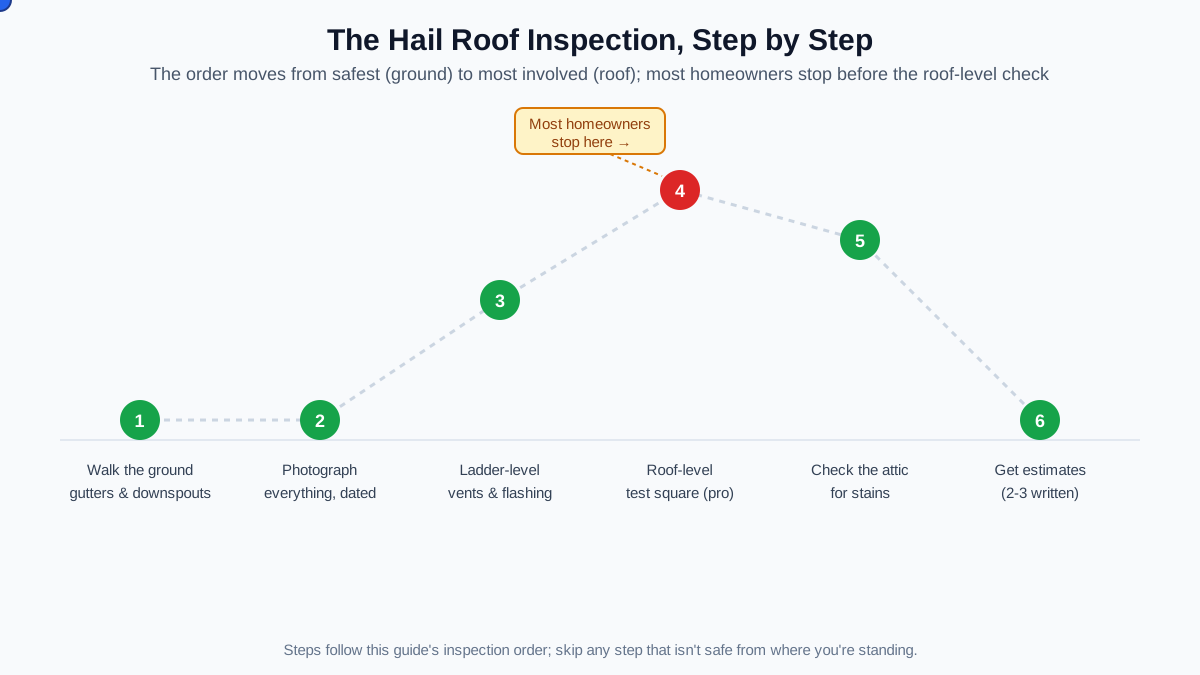
A proper hail damage roof inspection follows a routine, whether it's you checking from a safe vantage point or a contractor walking the slopes. The order matters because it moves from safest to most involved.
Check the weather and wait for a dry, calm day, since wet shingles covered in loose granules are one of the most slippery surfaces a person can stand on.
Walk the ground first: gutters, downspouts, AC unit, mailbox, deck rails, and any other exposed metal or vinyl for fresh dents.
Photograph everything from the ground with a timestamp, including wide shots of each slope and close-ups of any obvious dents.
If it's safe and you're comfortable on a ladder, inspect soft metal roof components (vents, flashing, and drip edge) for the same scattered dent pattern.
Mark a test square, roughly 10 feet by 10, on one or two representative slopes and count hits within it; this is the same method insurance adjusters and contractors use to judge overall severity.
Check the attic from inside for new water stains, daylight through the decking, or a damp smell, which point to punctures that need attention regardless of what the outside looks like.
Get two or three written estimates from licensed local roofers before you commit to any repair, and keep every photo and estimate together in one folder for the insurance claim.
Most homeowners are better off stopping at step four and calling in a professional for the roof-level inspection. A contractor with fall protection and hail-specific training can complete the same walkthrough in under 1 hour and will document it in a format your insurer already recognizes. For the complete walkthrough beyond hail-specific checks, including how often a roof needs one, see our roof inspection guide.
The inspection moves from safest to most involved: most homeowners stop after the ladder-level check and hand the roof-level test square off to a licensed contractor.
Fixing Hail Damage: What You Can Do and What Needs a Pro
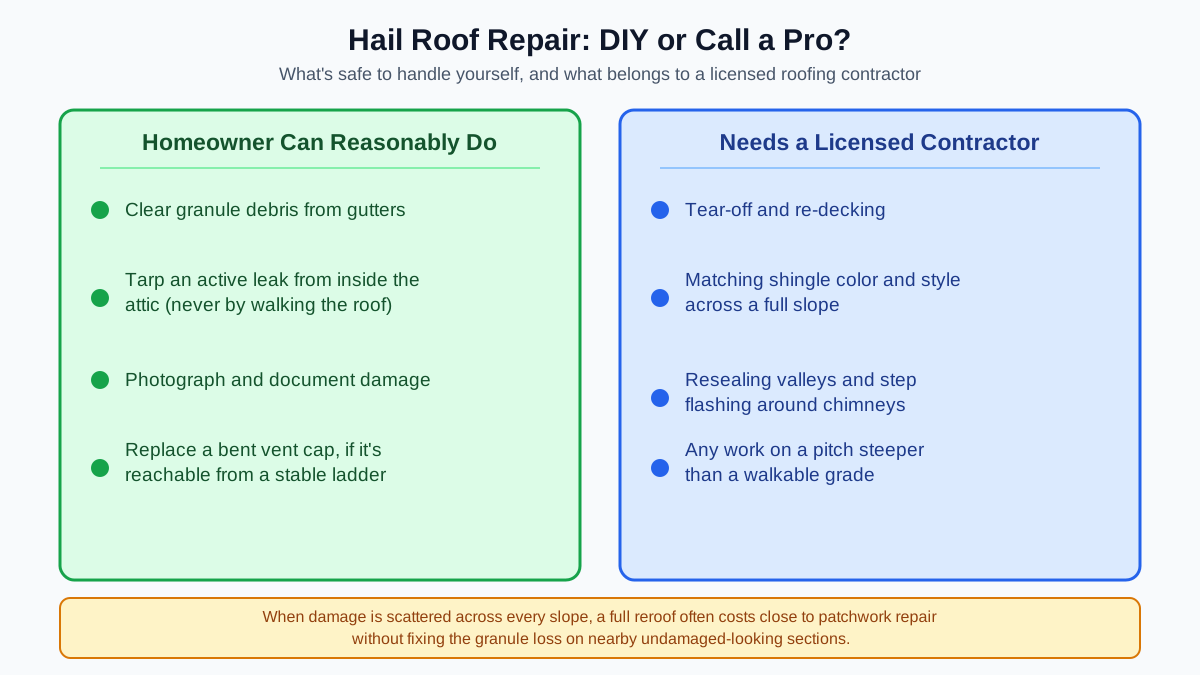
The honest answer for most hail damage is that DIY fixes are limited to stopgaps, not permanent repairs. That's not a sales pitch; it's a function of how shingles are installed. Replacing a single shingle correctly means lifting the row above it without cracking the sealant strip, sliding the old one out from under the nails, and re-sealing the new one so it won't lift in the next windstorm. Done wrong, it creates a new leak point instead of fixing one.
What a homeowner can reasonably do
You can safely clear granule debris from gutters so downspouts don't clog, put a tarp over an active leak from inside the attic (never by walking a damaged roof), and photograph and document damage for the claim. If a single flat or coil roofing vent cap is bent and easy to reach from a stable ladder, replacing it is a manageable weekend task for someone comfortable with basic tools.
What belongs to a licensed roofing contractor
Anything involving tear-off and re-decking, matching shingle color and style across a full slope, resealing valleys and step flashing around chimneys or skylights (a job that runs $200 to $500 on its own, according to Fixr and This Old House), or working on a pitch steeper than a walkable grade needs a professional with fall protection and liability insurance. A contractor also has access to matching shingle runs from the same manufacturer lot, which matters more than it sounds, since mismatched shingles from a different production run are one of the most common complaints after a partial repair.
For roofs with damage scattered across every slope, most contractors will recommend a full reroof rather than patchwork repair, since spot-repairing a dozen separate areas often costs close to what a full tear-off would, without solving the granule loss on the undamaged-looking sections nearby. For repair-only pricing beyond hail specifically, see our roof repair cost guide.
Most hail fixes beyond debris cleanup and documentation call for a licensed roofer, since a mis-installed shingle or mismatched repair often creates a new leak point.
What Hail Damage Roof Repair Costs
Costs vary by how much of the roof is affected, the material, and local labor rates, which run $50 to $120 an hour for roofing crews nationally according to Fixr, but published cost surveys give a reliable range to start from. Hail-specific repairs nationally run $700 to $4,000, according to matching figures from Fixr, This Old House, and Bob Vila. Below is how that breaks down by scope, plus what a full reroof runs if the damage is bad enough to justify replacement instead of repair.
Job type
Typical range
What moves the price
Source
Minor hail repair (a dozen or so shingles)
$150 – $1,000
Number of shingles, whether the exact color and style are still in production
Fixr, This Old House
Moderate hail repair (one or two slopes, flashing, vents)
$1,000 – $3,000
Slope count, roof pitch, flashing and vent replacement
Fixr
Major hail repair (large sections, exposed decking)
$2,000 – $8,000
Decking replacement, scope of tear-off, material
This Old House
Hail-specific repair, national average
$700 – $4,000
Hailstone size, roof material, storm severity
Fixr, This Old House, Bob Vila
Full roof replacement, if hail forces a reroof
$5,700 – $16,000 (national averages cluster near $10,000)
Material choice, roof size and pitch, local labor rates
Fixr, HomeAdvisor, HomeGuide
Post-storm roof inspection
$100 – $600
Roof size, ladder vs. drone access, number of slopes
This Old House
Hail-specific repairs average $700 to $4,000 nationally; damage severe enough to justify a full reroof runs $5,700 to $16,000.
How we got these numbers
These are national survey ranges, pulled from four independent cost-data publishers, not a quote for any specific roof. Material is usually priced by the roofing square, the trade's unit for 100 sq. ft. of coverage: three-tab shingles run $80 to $130 per square and architectural shingles $100 to $250, according to HomeGuide, and labor makes up 40 to 60 percent of a full reroof's total cost, per Fixr, which is one reason matching a single damaged slope to the rest of the roof costs more than the material price alone suggests. A wider study by the Zonda Cost vs. Value 2025 report put the job cost for a full asphalt shingle reroof at $31,871 in a defined remodeling-scope project, recouping about 68 percent of that at resale, a useful reminder that replacement cost and resale value aren't the same number. Your own price depends on roof size, pitch, material, and how busy local roofers are after a wide-area storm, so treat every range here as a starting point and get a written estimate for your address before you budget a final figure. See our roof replacement cost guide for the full breakdown by material and roof size.
Filing a Hail Damage Insurance Claim
A hail damage insurance claim moves through a handful of predictable stages on a standard HO-3 homeowners policy, which typically covers wind and hail as a named peril. Filing quickly and with good documentation is the single biggest factor in how smoothly it goes.
A hail damage insurance claim typically moves from documentation to an insurer call, an adjuster inspection and ACV payment, then a final payment once repairs are complete.
Documentation before you call
Photograph every angle of visible damage, the date of the storm from a local news source or weather record, and any dents on ground-level metal. If you already have a contractor's inspection report with test-square hit counts, that becomes part of your claim file too. Keep receipts for any emergency tarping or temporary repairs, since those are usually reimbursable under the policy's mitigation coverage. On a typical timeline, that documentation happens in the first 2 days after the storm, the call to open the claim and the written estimates follow over the next 3 to 10 days, and the adjuster inspection with an initial ACV payment usually lands 2 to 6 weeks after that.
ACV, RCV, and depreciation
Most policies pay in two parts. The first check reflects actual cash value (ACV), replacement cost minus depreciation for the roof's age. Once the repair or replacement is complete and you submit the final invoice, the insurer releases the recoverable depreciation, bringing the total up toward replacement cost value (RCV), assuming your policy includes RCV coverage rather than ACV-only. Ask your adjuster directly which type of policy you have, because that difference can run into thousands of dollars.
Company adjuster vs. public adjuster
Your insurer sends its own adjuster to inspect and estimate the damage at no direct cost to you. A public adjuster works for you instead, for a percentage of the settlement, and can be worth hiring on a large or disputed claim where the insurer's estimate looks low relative to your contractor's written estimate. For a straightforward, well-documented claim, most homeowners don't need one.
Never sign an assignment of benefits or any contract giving a roofing company authority to negotiate directly with your insurer before you've read every line and confirmed the company is licensed, insured, and has a permanent local address. That single document is where a large share of storm-season disputes start.
Deadlines to file are set by your policy and, in many cases, your state's insurance code, not by one national rule. Check your policy's declarations page for the filing window, and contact your state insurance department if you're not sure which deadline applies to your claim.
Avoiding a Storm Chasers Roofing Scam
Within days of a major hailstorm, out-of-state crews often work neighborhoods door to door, and most of them are not licensed to work in your county. The clearest way to spot a storm chasers roofing scam is the sequence of the pitch: a knock at the door, a free inspection offer before you've called anyone, and pressure to sign a contract on the spot, often paired with a promise to "cover your deductible" or hand you cash back. Roofers call these crews storm chasers because they follow the hail line from state to state and are gone before a warranty claim would ever come due.
Red flags worth remembering
Watch for a business card with no permanent local address, a request for the full payment up front before any work starts, refusal to provide proof of state licensing or liability insurance, and pressure to sign an insurance assignment before an adjuster has even inspected the roof. Waiving or rebating your deductible is illegal in most states, since it's a form of insurance fraud that shifts the cost onto every other policyholder. A company willing to offer that openly is telling you something about how it operates.
What a legitimate crew looks like instead
A real local contractor carries a current state license and general liability insurance, can show manufacturer certifications, such as NRCA training or an Owens Corning preferred-contractor listing, and gives you a written estimate that itemizes materials, labor, permit costs, and a start and completion timeframe rather than a single lump number. If you'd rather start with a name you can verify than a door-knocker with a magnetic sign, call 888-679-3798 to reach a roofing contractor that serves your area and can walk you through what an honest estimate should include. For the full checklist of licensing, insurance, and contract red flags, see how to choose a roofing company.
Hail Damage vs. Wind Damage Roof Repair
Hail and wind usually arrive in the same storm system, and most homeowners policies bundle them under one wind and hail peril, so a wind damage roof repair is documented and filed almost the same way a hail claim is. The damage itself looks different once you know what to check: hail leaves bruises, wind leaves lifted or torn shingles.
Sign
Hail damage
Wind damage
Shingle pattern
Random, roughly circular bruises and dents scattered across a slope
Shingles lifted, creased, or torn near the tab edge and sealant line
Soft metals
Dented vents, flashing, gutters, AC fins
Bent or torn flashing, ripped ridge caps, debris strikes
Where it shows up
Scattered across every slope, heavier on the side facing the storm
Concentrated on the windward slope, or at ridges and edges where uplift is strongest
What an adjuster checks
Test-square hit counts, exposed mat
Crease lines, missing tabs, lifted sealant strips
Typical claim path
Filed under the wind and hail peril on a standard HO-3 policy
Filed under the same wind and hail peril on a standard HO-3 policy
Cost tends to track that same variability: wind-specific roof repairs run $250 to $6,500 nationally, according to Fixr, a wider span than hail-specific repairs, since a handful of lifted shingles costs far less to reseal than a torn-off section of decking.
In practice, a single storm often leaves both patterns on the same roof: bruised shingles from hail on one slope and lifted, creased shingles from wind gusts on another. A contractor documenting the claim should note both separately, since an insurer's estimate may treat them as different line items even though they came from the same event.
When to Call a Pro, and Where DIY Ends
Hail damage rarely creates the kind of same-day emergency a burst pipe does, but a few situations do need immediate attention rather than a wait-and-see approach. If you already see water coming through the ceiling or insulation sagging overhead after a hailstorm, that's not a problem to leave until morning. Call 888-679-3798 and describe what you're seeing so you can get connected with a roofing contractor that serves your area, and in the meantime keep people and furniture clear of the room underneath. Our roof leak repair guide covers how to slow an active leak from inside while you wait for a crew.
Safety limits that apply to everyone
Do not walk a roof that's wet, steep, or covered in loose granules; that combination is genuinely dangerous even for people used to ladders. Stay off the roof entirely if you can see sagging decking from inside the attic, since that's a sign the structure itself may be compromised. And never work near a downed power line or a service mast that was hit by falling debris; treat any electrical damage as a job for the utility company first, roofer second.
When a repair estimate should give you pause
If an estimate arrives within hours of a storm, quotes a number far above what the cost ranges above suggest, or the company can't produce a license number when asked, get a second opinion before signing anything. A short delay to get a competing written estimate almost never makes hail damage worse, since the bruising has already happened; what makes it worse is an active leak left unaddressed for weeks.
Reducing Hail Damage Before the Next Storm
You can't stop hail from falling, but you can change how much damage the next storm does. Impact-resistant shingles are built and tested specifically to absorb hail energy without cracking, rated under the industry's UL 2218 impact test, where Class 4 is the highest of four classes and the rating most insurers look for, and they hold up better across repeat storms than standard three-tab or architectural shingles rated for lighter impact. If you live somewhere that sees hail most years, replacing a roof that's already near the end of its life with impact-resistant shingles is worth pricing out alongside a standard reroof.
Maintenance that pays off
Trim back branches that overhang the roofline, since falling limbs during the same storm that brings hail add a second source of impact damage. Clean gutters twice a year so granule debris and leaf litter don't trap water against the fascia. And schedule a roof check after any storm season even when nothing looks obviously wrong from the ground, since catching a bruised shingle before it cracks all the way through is far cheaper than repairing the water damage that follows a full-blown leak.
Talk to your insurer before the next storm, not after
Ask directly whether your policy covers roofs on an actual cash value or replacement cost basis, and whether the company offers a discount for impact-resistant materials. Some insurers also apply a separate, higher deductible specifically for wind and hail claims rather than your standard deductible, which is worth confirming now so it isn't a surprise during a claim.
Regional Notes: Hail Alley, the Freeze Belt and the Hurricane Coast
Hail risk in the US is not evenly spread, and the 2025 event count from the Insurance Information Institute makes the geography clear: Texas led the country with 902 major hail events, followed by Kansas with 375, Oklahoma with 369, Nebraska with 315, and Missouri with 253. That central swath, often called Hail Alley, sees more large-hail days per year than almost anywhere else on the continent, and roofing companies there build entire crews around storm response.
Where claims actually get paid
The states where insurers pay out the most hail claims don't always match the states with the most events. State Farm's data on hail claims paid points to Minnesota, Texas, Arkansas, Illinois, and Nebraska as its top states for hail losses, reflecting a mix of storm frequency and how much roofing stock is exposed in each state. Nationally, State Farm alone paid more than $3.5 billion in hail claims in 2022, over a billion dollars more than the year before.
Freeze belt and hurricane coast
In colder northern states, hail season and ice-dam season are separate problems on the same roof: a shingle bruised by summer hail is more likely to crack once winter ice dams start forcing meltwater backward under the shingle line, and ice dam removal alone typically runs $400 to $1,500 according to Fixr, before any hail-related shingle repair is added on top, as covered in our ice dam guide. Along the Gulf and Atlantic coasts, hail is less frequent but often arrives bundled with hurricane-strength wind and wind-driven rain, so a post-storm inspection there needs to check both hail bruising and wind-lifted shingles at the same time, plus flashing around any low-slope sections that are more common on coastal homes.
Frequently asked questions
How much hail damage does it take before a roof needs to be replaced?+
There's no single hit count that triggers replacement; it depends on how widespread the bruising is and the roof's age. A roof with scattered damage across most slopes, or one that's already near the end of its shingle life, usually gets replaced rather than patched, since spot repairs on a dozen separate areas often cost close to a full reroof.
Will insurance pay for hail damage to my roof?+
Most standard HO-3 homeowners policies cover hail as part of the wind and hail peril, so yes in the majority of cases, once you document the damage and file a claim. Coverage details, your deductible for wind and hail specifically, and whether payment is actual cash value or replacement cost value all depend on your individual policy.
Can a hail-damaged roof be repaired, or does it need full replacement?+
Many hail-damaged roofs can be repaired if the damage is limited to one or two slopes and the shingles are still in reasonably good condition otherwise. Repair becomes impractical once damage is scattered across every slope or the roof was already old, at which point a licensed contractor will usually recommend a full reroof instead.
Does a roof warranty cover hail damage?+
Most manufacturer shingle warranties cover material defects, not storm damage, so hail is typically excluded unless you purchased a specific storm or impact-resistance rider. Your homeowners insurance policy, not the shingle warranty, is almost always the coverage that applies to hail damage.
How much does it cost to repair hail damage on a roof?+
Hail-specific repairs run about $700 to $4,000 nationally, according to matching data from several cost-survey publishers, with the final number depending on how many shingles need replacing, the roof material, and whether flashing or decking is also damaged. A full reroof, if the damage is severe enough, typically runs $5,700 to $16,000.
Is it worth filing an insurance claim for hail damage?+
If the damage exceeds your deductible and a contractor confirms real bruising or cracking, filing is usually worth it, since the wind and hail peril is exactly what your premium is paying for. For very minor, cosmetic-only damage below your deductible amount, filing may not change your out-of-pocket cost and could still appear on your claims history.
What does hail actually do to a roof?+
On asphalt shingles, hail bruises the mat under the granule surface and knocks granules loose, which lets water and UV light reach the shingle faster even when it still looks intact. On metal it dents the panels, on wood shakes it can split the grain, and on tile it can crack or shatter the material outright.
How do I file an insurance claim for wind damage to my roof?+
Photograph the damage, note the storm date, and call your insurer promptly to start the claim, the same process used for a hail claim since both usually fall under one wind and hail peril. An adjuster will inspect the roof, and you'll typically receive an actual cash value payment first, with any recoverable depreciation released after the repair is complete.
Does homeowners insurance cover wind damage to a roof?+
Yes, in most cases, a standard HO-3 policy covers wind damage under the same named peril that covers hail. Exclusions and deductible amounts vary by insurer and by state, particularly in coastal areas where a separate, higher wind or hurricane deductible often applies instead of your standard one.
How can I tell wind damage from hail damage on a roof?+
Hail leaves random, roughly circular bruises and dents scattered across a slope, while wind tends to lift, crease, or tear shingles near the tab edge and sealant line, concentrated on the side of the roof that faced the gusts. Many storms produce both patterns on the same roof, and a contractor documenting a claim should note each separately.