A true HVAC emergency threatens health or the house itself: no heat during a hard freeze, no cooling during a heat advisory with a medically fragile occupant, a gas smell, or a sounding carbon monoxide alarm. Call for emergency HVAC service in those cases. A dead thermostat display or a noisy blower, on their own, can almost always wait for regular business hours instead.
It is always the same story. The furnace goes quiet at eleven at night in January, or the air conditioner starts blowing warm air on the first 100-degree afternoon of the summer, and you are standing in the hallway trying to decide whether this is a five-alarm problem or something that can sit until the shop opens. That decision matters more than most homeowners think. Call for emergency HVAC service on a problem that could have waited, and you pay an after-hours rate for a part swap that would have cost half as much at ten in the morning. Wait out a problem that genuinely cannot wait, and you risk frozen pipes, heat-related illness, or, in the worst cases, a carbon monoxide leak from a cracked heat exchanger.
This guide walks through how to tell the difference in the next ten minutes, what a safe do-it-yourself check looks like versus what belongs to a licensed technician, what emergency and non-emergency HVAC repair actually costs across the country, and how to get a crew out fast without paying for panic. None of the numbers below are guesses. They come from national contractor cost surveys and fire-safety data cited at the bottom of the page, because the last thing anyone needs at midnight is an estimate someone made up on the spot.
What Actually Counts as an HVAC Emergency
Not every silent thermostat is a crisis, and treating it like one is how homeowners end up paying emergency hourly rates for work that could have waited twelve hours. Contractors generally sort HVAC problems into three buckets: safety emergencies, where the problem itself can hurt someone or the house; comfort emergencies, where the loss of heating or cooling is dangerous because of who is home and what the weather is doing; and everything else, which is annoying but not urgent.
A safety emergency means real, immediate danger: a gas smell near the furnace, a carbon monoxide alarm sounding, sparking or a burning-plastic odor from the equipment, or standing water pooling near an electrical panel. These get a call right away, any hour, any day of the week.
A comfort emergency is about occupants and weather, not just equipment. No heat during a hard freeze with an infant, an elderly resident, or anyone on home medical equipment in the house is an emergency. No cooling during a heat advisory with those same occupants is an emergency. Nobody living through a no cooling emergency in an empty vacation home on a mild week needs to pay a premium rate to fix it tonight, but a household with a newborn and a heat index over 100 does.
Situation
Call now, any hour
Can usually wait for business hours
Gas smell, hissing near the furnace, or a sounding CO alarm
Yes, leave the house first
—
No heat, indoor temp near or below 50°F, vulnerable occupant present
Yes
—
No cooling in a heat advisory, medically fragile occupant present
Yes
—
Sparking, burning smell, or a breaker that will not stay reset
Yes
—
System dead, house still comfortable, nobody at extra risk
—
Yes, next business day
Odd but steady noise, system still running normally
—
Yes
Water pooling near the indoor unit, no electrical risk
—
Shut off, mop up, then schedule
Thermostat blank, breaker and batteries not yet checked
—
Check first, then decide
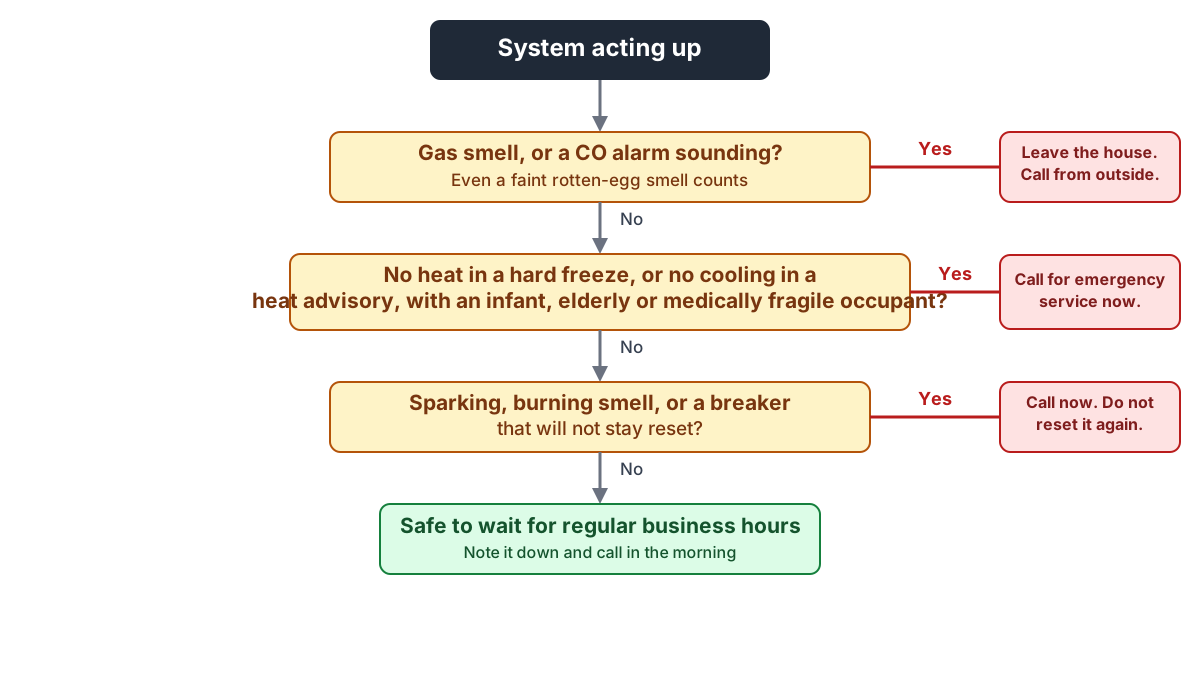
The flowchart below walks through the same logic visually. It is worth a screenshot for the next time a system quits at a bad hour.Gas smell or CO alarm, extreme-weather no-heat/no-cool with a vulnerable occupant, or electrical sparking all mean call now. Otherwise it can usually wait.
Why Systems Fail: Causes Ranked by How Often They Happen
Knowing the usual suspects speeds up every conversation with a technician, whether that call happens at 2 p.m. or 2 a.m. The two sides of the system, cooling and heating, fail for different, fairly predictable reasons.
On the cooling side
A failed capacitor is the single most common reason a central air conditioner refuses to start, especially on the hottest day of a heat wave when the extra electrical strain finally finishes off a part that was already weak. Next most common is a refrigerant leak, which shows up as steadily worsening cooling rather than a sudden stop. After that comes a frozen evaporator coil, usually triggered by a dirty filter or low refrigerant restricting airflow, then a failing compressor, and finally electrical issues like a tripped breaker or a bad contactor.
On the heating side
A worn ignitor or a dirty flame sensor causes more no-heat calls than anything else, because both parts sit directly in the flame path and degrade with every heating cycle. A failing blower motor is next, often announced by a burning-dust smell the first time the furnace fires up for the season. Control board failures and gas valve problems follow. A cracked heat exchanger is comparatively rare, but it is the one cause on this list that turns a repair call into a safety call, because a cracked exchanger can leak combustion byproducts into the air the furnace is supposed to be warming.
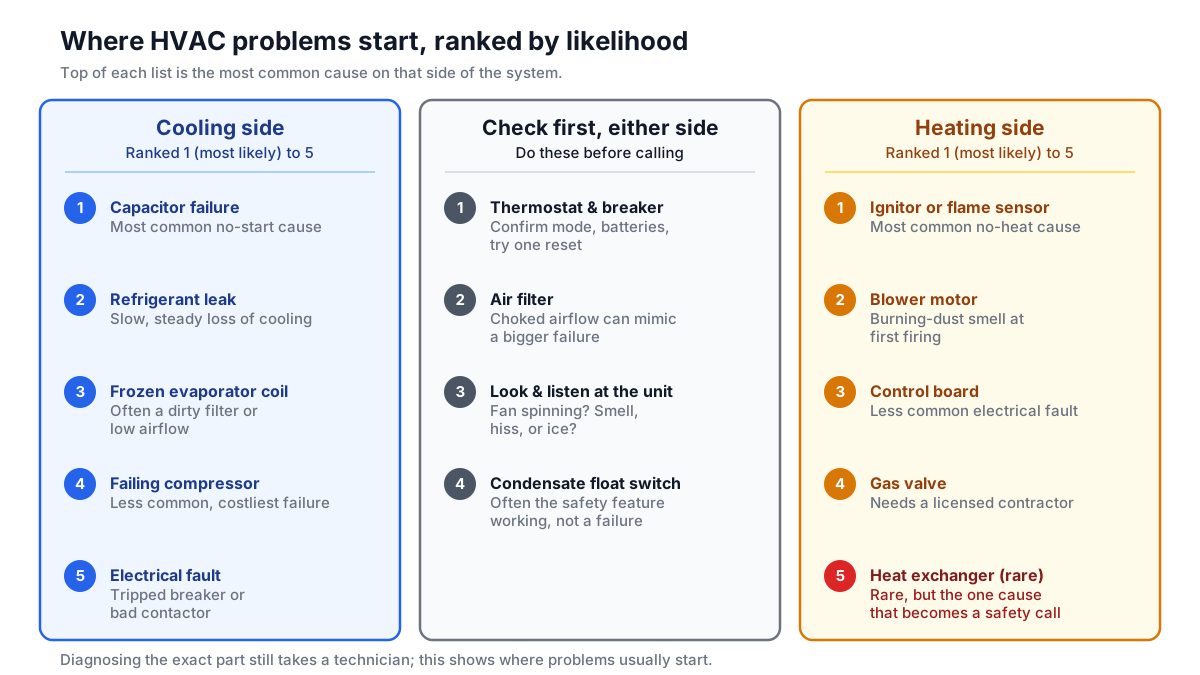
None of this is a reason to self-diagnose a part and order it online before anyone has opened the panel. It is a reason to describe symptoms precisely when a technician does show up, because "the outdoor fan is not spinning and I hear a hum" gets you a faster, cheaper visit than "the AC is broken."The most common failure on each side of the system sits at the top of its list; the middle column is what to check before calling anyone.
How to Diagnose It Before You Call Anyone
Ten minutes of checking, done in the right order, tells you whether this is a five-minute fix, a same-day repair, or a genuine emergency HVAC service call. Work through these steps before you touch anything electrical you are unsure about.
Check the thermostat first: confirm it is set to heat or cool as needed, the display is lit, and the batteries (if any) are not dead. A blank screen is often a battery, not a broken system.
Check the breaker panel and any dedicated disconnect near the outdoor unit or furnace. A single reset is reasonable; a breaker that trips again immediately means stop and call, because that is the system telling you something is actively shorting.
Look and listen at the unit itself. Is the outdoor fan spinning? Is there a burning smell, a hissing sound, or visible ice on the coil or refrigerant lines? Write down exactly what you notice.
Check the air filter. A filter that has not been changed in months can choke airflow badly enough to freeze a coil or overheat a furnace's limit switch, and swapping it is free troubleshooting.
Check the condensate drain and float switch on the indoor unit, a small sensor that shuts the system off when the drain pan fills so it cannot overflow onto the floor. Many systems doing this look "broken" when the safety feature is actually working correctly.
Note the time it started, what you smell or hear, and any error code or blinking light pattern before you call. That single step routinely cuts diagnostic time on the technician's first visit.
If step two turned up sparking, a scorched smell, or a breaker that will not hold, stop the checklist there. That is no longer a do-it-yourself situation.
What You Can Safely Fix Yourself
A short list of fixes is genuinely within reach for most homeowners, and doing them first can turn an emergency ac repair into a non-event.
Replacing a dirty air filter, which is the single most common cause of weak airflow on both the heating and cooling side.
Resetting a tripped breaker one time, then watching to see whether it holds.
Replacing thermostat batteries and confirming the schedule or mode settings are correct.
Clearing leaves, grass clippings, or ice away from the outdoor condenser unit so air can move through the coil.
Resetting a tripped condensate float switch after mopping up standing water beneath the indoor unit, and clearing a visibly clogged condensate line with a wet-dry vacuum at the outdoor termination point.
Straightening a bent register or opening a closed vent that is starving one room of airflow.
What does not belong on this list: anything involving refrigerant, gas lines, the electrical panel beyond a single breaker reset, or opening a sealed furnace or compressor housing. If the quick checks in the step-by-step diagnosis for a system that will not cool or a no-heat furnace do not resolve things in a few minutes, that is your signal to stop troubleshooting and start calling.
When the Problem Needs a Licensed Technician, Not a Video Tutorial
Federal law is unambiguous on one part of this: under the Clean Air Act's Section 608 program (40 CFR Part 82, Subpart F), anyone who services, repairs, or disposes of equipment that could release refrigerant into the atmosphere has to hold EPA certification. Certification comes in four tracks — Type I for small appliances, Type II for high-pressure systems like most home central air and heat pumps, Type III for low-pressure systems, and Universal for technicians who work across all three — on top of a required Core exam. That alone rules out do-it-yourself refrigerant top-offs or recovery, no matter how simple the gauge set looks online.
Beyond refrigerant, a handful of other repairs genuinely belong to a licensed HVAC contractor: gas valve or gas line work, any repair involving the heat exchanger, compressor replacement, control board or wiring diagnosis beyond a single breaker, and anything that requires opening a sealed refrigerant circuit. These jobs combine high-voltage electricity, pressurized gas lines, or combustion equipment, and a mistake in any of them can be far more expensive, and more dangerous, than the original problem.
There is also a simple financial argument for calling sooner rather than later once you are past the basic checklist. A homeowner who keeps poking at a failing blower motor for 3 days before calling anyone often turns a $300 repair into a $2,000 one, because the motor finally seizes and takes the transformer or control board with it. If you smell gas or a carbon monoxide alarm is sounding, get everyone out of the house immediately, call your gas utility or 911 from outside, and do not touch the thermostat, light switches, or anything electrical until a professional says it is safe.
What Emergency HVAC Service Actually Costs
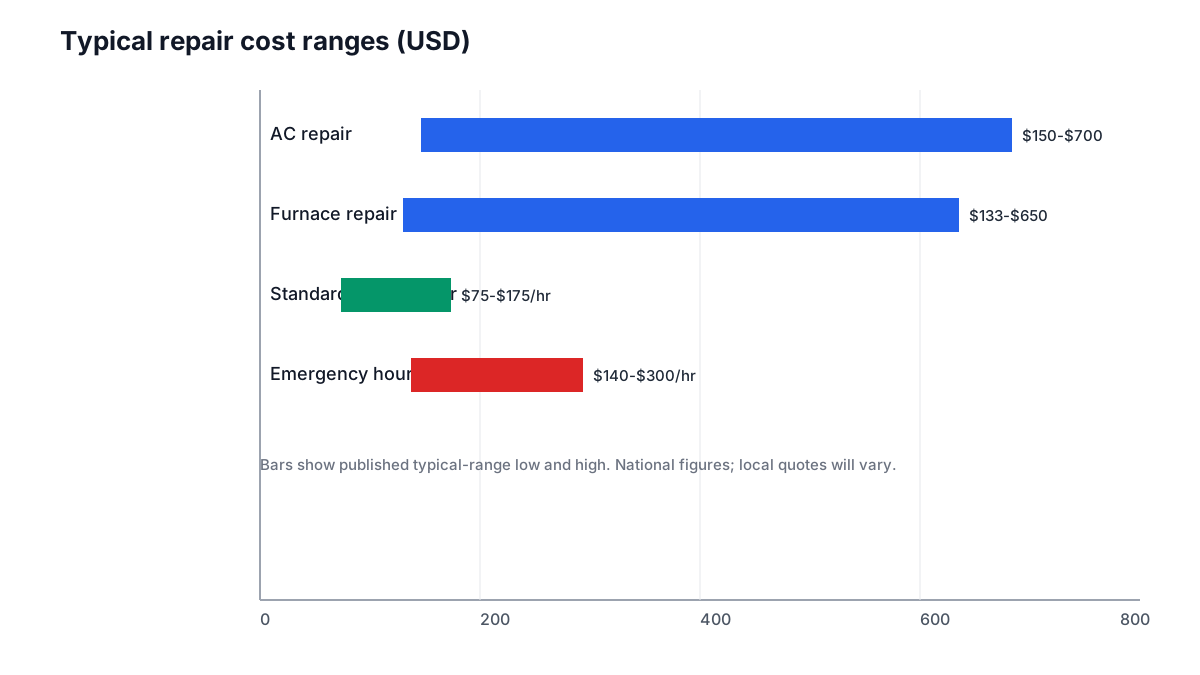
The hvac emergency cost conversation really comes down to two numbers: the daytime service call fee, a flat charge just to have a technician show up and look, and the after-hours premium layered on top of it. National cost surveys put a standard HVAC service call at $75 to $200, with an hourly labor rate of $75 to $175 once the technician is diagnosing or repairing. After hours, on weekends, or on holidays, that hourly rate commonly jumps to $140 to $300, which is the real cost of emergency HVAC service: not a different repair, just a different clock.
Job type
Typical range
What moves the price
Source
AC repair, general
$150-$700 (avg $319-$375)
Part failed, refrigerant type, after-hours surcharge
HomeGuide 2025; Fixr 2026
Furnace repair, general
$133-$650 (avg $318-$485)
Ignitor vs. heat exchanger vs. blower motor, brand
HomeAdvisor 2026; Fixr 2025
Standard hourly labor
$75-$175/hr
Region, contractor overhead, complexity
HomeGuide; Fixr
Emergency/after-hours labor
$140-$300/hr
Time of night, holiday, drive distance
HomeGuide; Fixr
Capacitor replacement
$100-$400
Single vs. dual-run capacitor, brand
HomeGuide; Fixr
Blower motor replacement
$150-$2,000
Motor type, accessibility, whether the control board also failed
HomeAdvisor; Fixr
Heat exchanger repair
$100-$3,000
Often the math tips toward replacing the whole furnace instead
HomeGuide; HomeAdvisor; Fixr
Full AC replacement
$2,900-$9,000 (avg $5,977)
Tonnage, SEER rating, ductwork condition
HomeAdvisor 2026
Full furnace replacement
$2,000-$10,000 (avg $4,800-$4,814)
Fuel type, permits, removal of the old unit
HomeAdvisor 2026; Fixr 2026
How we got these numbers: the ranges above are researched ranges pulled directly from published national contractor cost surveys — not a quote, and not averaged or adjusted by us. They reflect the country as a whole; only a written estimate from a local contractor, priced for your address, your equipment, and your local labor market, is actually binding. The final number varies by region, by how hard the equipment is to access, and by what the technician finds once the panel or ductwork is open. If a company will not put a number in writing before starting work, that is a red flag covered later in this guide.
The chart below lines up the repair-only ranges side by side, which makes the after-hours premium easier to see at a glance.Repair costs and the after-hours labor premium, based on published national contractor cost surveys.
Signs This Is a Fire or Poisoning Risk, Not Just a Broken System
This is the one category where cost should not enter the decision at all. National fire data backs up why: U.S. fire departments respond to an estimated 44,210 home heating equipment fires a year on average, causing about 480 civilian deaths, 1,370 injuries, and more than a billion dollars in direct property damage, according to NFPA's analysis of 2016-2020 data. A more recent NFPA release covering 2019-2023 puts the average closer to 38,881 fires a year, with roughly $1.1 billion in damage. Portable space heaters, brought in as a stopgap when a furnace fails, are a disproportionate share of both counts: they cause under a third of home heating fires but a large majority of the deaths, because people run them unattended or too close to bedding and furniture.
That statistic matters directly here, because the instinct when a furnace dies overnight is to grab a space heater and wait until morning. That is a reasonable short-term move for one room, for a few hours, on a plugged-in circuit that is not overloaded, with the heater kept clear of anything flammable and never left running while everyone sleeps. It is not a substitute for calling about the furnace itself once it is safe to do so.
A carbon monoxide leak from a cracked heat exchanger or a blocked flue, the pipe that is supposed to carry combustion exhaust outside, is the more dangerous failure mode, and it is often silent: no smell, no visible damage, just a slowly rising level of a gas that displaces oxygen in the blood. A chirping or sounding CO alarm, headaches that ease when you leave the house, or flu-like symptoms that hit everyone in the house at once and improve outdoors are all signals to leave immediately and call from outside, the same as a gas smell.
How to Get a Crew Out Fast Without Getting Overcharged
Searching for 24 hour ac repair or same day ac repair tends to surface the same handful of larger companies in any metro area, the ones with enough technicians on staff to run an hvac after hours rotation. Before any of them touch your system, a few checks protect you from both bad work and overpaying.
Credentials worth asking about
Ask whether the technician holds NATE certification, the North American Technician Excellence credential earned by passing five separate 30-question exams covering HVAC fundamentals, electrical and controls, comfort and airflow, installation, and service, with recertification required every 2 years through 16 hours of continuing education or a retake of the specialty exam. Ask whether the company carries current liability insurance and a valid state or local contractor license, and verify that license number against your state's contractor licensing board before anyone starts work — a license that comes back inactive or unlisted is a reason to call someone else. Confirm the technician doing any refrigerant work is Section 608 certified, which federal law already requires of them.
Red flags
Walk away from anyone who demands full payment in cash before starting work, refuses to put a price in writing, pressures you into a same-visit system replacement for a repairable problem, or cannot produce a license number on request. A legitimate written estimate names the part or repair, the labor charge, the service call fee, any after-hours premium, and an approximate timeline, before the technician starts. Compare that against the full guide to vetting an HVAC contractor for a longer checklist if the decision can wait even thirty minutes.
Preventing the Next Middle-of-the-Night Breakdown
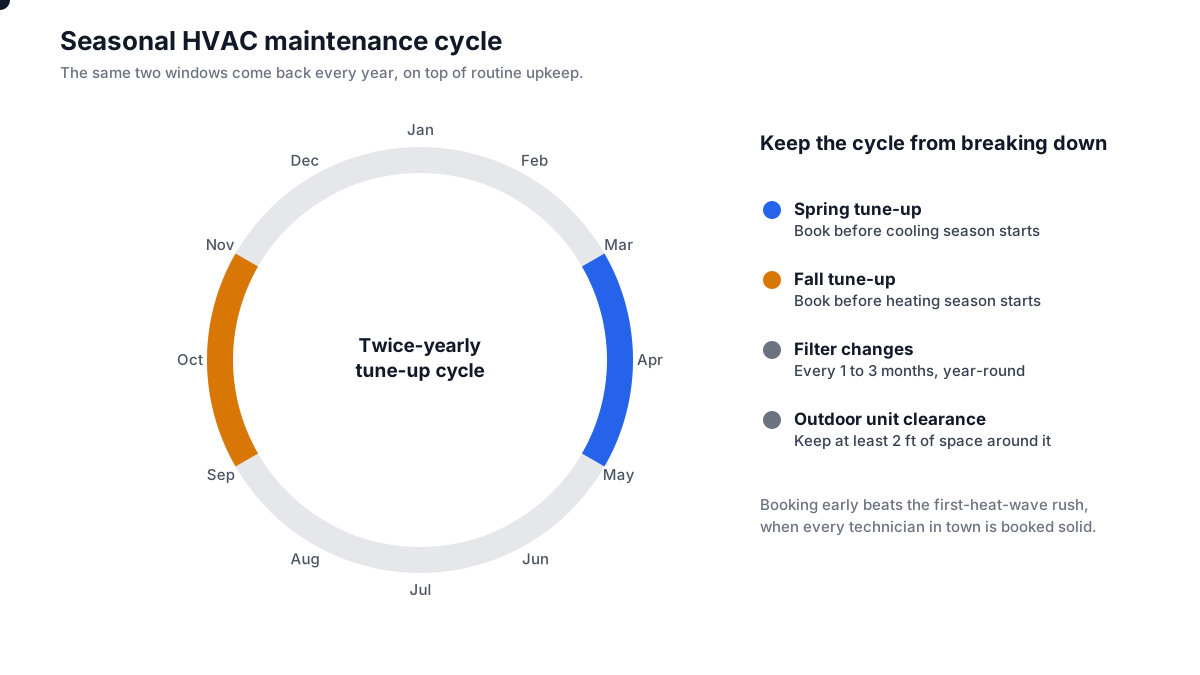
Most true emergencies trace back to a part that was already failing for weeks, not a sudden, unpredictable event. A twice-yearly tune-up, filter changes on a regular schedule, and clearing debris from around the outdoor unit catch the capacitor that is drawing slightly high amperage, the electrical current a healthy part should not be pulling, or the flame sensor that is coated just enough to cause intermittent shutdowns, long before either one strands a family at an inconvenient hour.
The seasonal maintenance checklist covers the specific tasks worth doing each spring and fall, but the short version is this: change the filter every 1 to 3 months depending on the household (a pleated filter in the 8 to 13 MERV range is the typical residential sweet spot — the MERV scale itself runs from 1 to 16, and anything much higher than 13 starts to choke airflow through a home system), keep at least 2 feet of clearance around the outdoor unit, and book a professional tune-up before the season that system depends on, not during the first heat wave or cold snap when every technician in town is already booked solid.
Duct cleaning and other add-on services are sometimes pitched as emergency-prevention, but they rarely move the needle on breakdowns the way basic maintenance does; it is worth knowing when that service actually helps before paying for it.A twice-yearly tune-up plus routine filter changes and outdoor-unit clearance are what keep a breakdown from becoming an emergency call.
Regional Notes: Freeze Belt, Hurricane Coast and Desert Heat
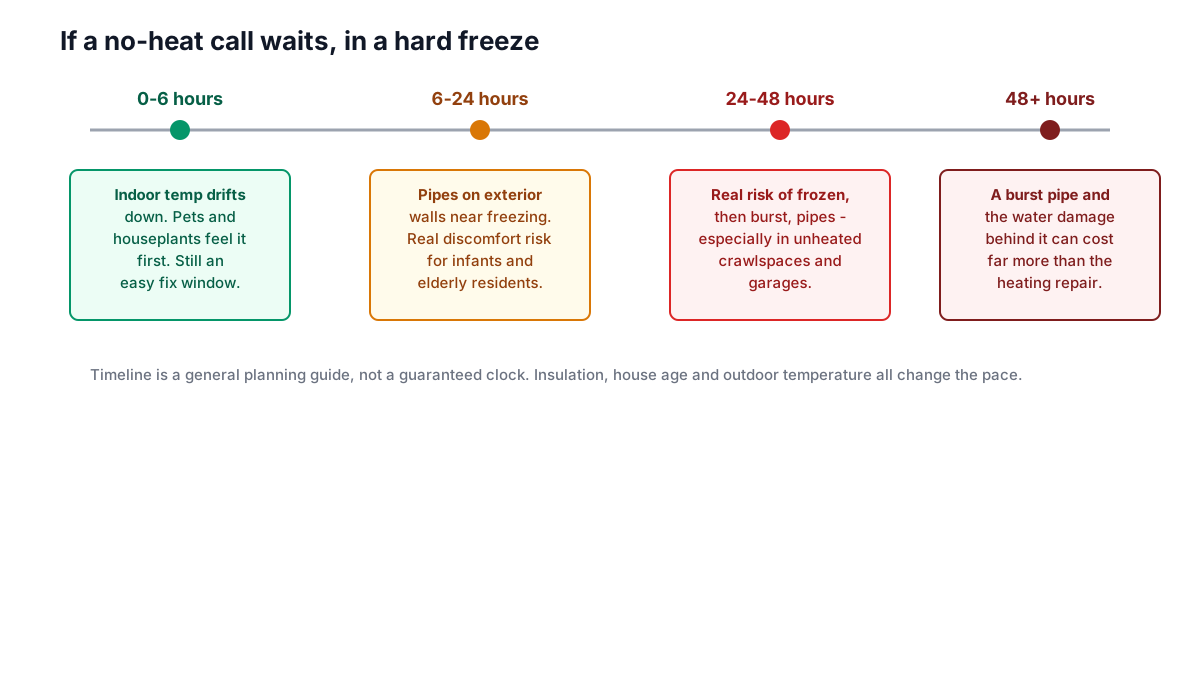
The same failure can carry very different stakes depending on climate. A furnace outage in a mild coastal city is an inconvenience; the same outage in a place where nights regularly drop well below freezing can escalate into a plumbing emergency within a day or two, because unheated pipes along exterior walls or in crawlspaces, the unheated gap under a house where supply lines often run exposed, start to freeze the moment the water inside them cools to 32°F, and an unheated house can reach that in well under a day during a hard freeze.
Region pattern
Typical failure mode
Urgent risk
Prevention focus
Cold-winter / freeze belt
Furnace ignitor, heat exchanger, blower motor
Frozen and burst pipes if heat is out more than a day
Fall tune-up, know where the water main shutoff is
Heat-related illness for elderly or medically fragile occupants
Spring tune-up, filter changes through peak cooling months
Hurricane and storm coast
Power loss taking down the whole system, storm debris in the outdoor unit
No cooling or heating for days during and after a storm
Surge protection, clear debris zone, generator plan
Hot, dry desert climates
Compressor strain, refrigerant leaks from prolonged high-load running
Extreme daytime heat with no cooling for vulnerable residents
Refrigerant check each spring, shade the outdoor unit if possible
The timeline below focuses on the freeze-belt scenario specifically, since it is the one where waiting has the clearest, fastest-compounding cost.What tends to happen when a no-heat call sits overnight, then a full day, in freezing weather.
Frequently asked questions
What is considered an HVAC emergency?+
A true emergency threatens safety or the house itself: a gas smell, a sounding carbon monoxide alarm, sparking or a burning smell from the equipment, or no heat or cooling combined with extreme weather and a vulnerable occupant, such as an infant, elderly resident, or anyone on home medical equipment. A dead thermostat display or an odd noise, on their own, usually is not.
How much does emergency HVAC service cost?+
Expect a standard service call fee of roughly $75 to $200 plus an after-hours hourly labor rate of about $140 to $300, compared with $75 to $175 an hour during business hours. The part or repair itself, such as a capacitor or ignitor, costs the same whenever it is replaced; the premium is for the timing.
How much does emergency AC repair cost?+
AC repair nationally runs about $150 to $700, averaging roughly $319 to $375, before any after-hours premium. Simple fixes like a capacitor land near the low end, while a compressor or evaporator coil replacement pushes toward the higher end of published ranges.
How much does emergency furnace repair cost?+
Furnace repair nationally runs about $133 to $650, averaging roughly $318 to $485, according to published contractor cost surveys. A worn ignitor or flame sensor is inexpensive to fix, while a blower motor or heat exchanger repair sits well above the average.
Is a broken air conditioner an emergency?+
It depends on the weather and who is home. A dead air conditioner during a heat advisory with an infant, an elderly resident, or someone with a heat-sensitive medical condition is an emergency worth an after-hours call. The same failure on a mild week in an otherwise empty house can usually wait for a regular appointment.
Does home insurance cover HVAC repair or replacement?+
Standard homeowners policies typically do not cover ordinary mechanical breakdown or wear from age, but they generally do cover HVAC damage caused by a covered peril, such as fire, lightning, or a burst pipe. Coverage details and exclusions vary by policy, so a homeowner should confirm the specifics with their own insurer before assuming either way.
How long does emergency HVAC repair take?+
A typical service visit runs 30 to 90 minutes once the technician arrives, assuming the part needed is already on the truck. Repairs that require an ordered part, such as a specific control board, can stretch to a day or more even when the diagnosis itself is quick.
Can I service my HVAC system myself?+
Basic upkeep is fine to do yourself: filter changes, clearing debris from the outdoor unit, thermostat batteries, and a single breaker reset. Refrigerant handling is not; federal law under the Clean Air Act's Section 608 program requires EPA certification for anyone who services equipment that could release refrigerant.
Does a home warranty cover emergency AC repair?+
Many home warranty plans cover HVAC repairs, but coverage usually comes with its own service call fee, exclusions for pre-existing problems or lack of maintenance, and sometimes longer response windows than a same-day private call. Reading the plan's HVAC section before an emergency happens avoids a bad surprise mid-crisis.
What is the difference between 24 hour AC repair and same day AC repair?+
24 hour AC repair means a company dispatches technicians around the clock, including overnight, usually at an after-hours premium. Same day AC repair means the company can typically get to a job within business hours on the day you call, without necessarily offering overnight dispatch at all.