Water damage restoration cost typically runs $1,200 to $6,369 for a single-incident job, with national averages between $3,000 and $3,868. Small category 1 spills can finish for $150 to $500, while a category 4 disaster with structural drying and mold work can run $20,000 to $100,000 or more. Square footage, water category, and how long the water sat before cleanup decide where your job lands.
A burst supply line under a kitchen sink and a sewage backup in the same square footage of flooring can produce bills that differ by a factor of ten. That gap is what confuses homeowners who call three companies and get three different numbers, and it's the reason a single, flat price for water damage restoration doesn't exist anywhere in the industry. What does exist is a set of variables every restoration company uses to build an estimate: how contaminated the water is, how much material absorbed it, how many square feet are affected, and how many hours passed before drying equipment showed up.
This guide walks through the real published cost ranges for water damage restoration, from a $150 spot dry-out to a six-figure disaster, and breaks down exactly what pushes a job from the low end of a range to the high end. It also covers what mold remediation and sewage cleanup typically add to a bill, how the water's category and class set the starting price, and what a written estimate should include before you sign anything.
What Actually Sets the Price of Water Damage Restoration
Call five different water damage restoration cost guides and you'll get five numbers within a few hundred dollars of each other, though none of them will match your invoice exactly. HomeAdvisor reports a national average of $3,868, typical range $1,383 to $6,369. Fixr reports $3,000 average, $1,200 to $5,000 typical. Bob Vila lands at $3,455, typical range $1,305 to $5,707. HomeGuide puts the common spend at $2,000 to $6,000, and Today's Homeowner reports a close $1,300 to $6,000. Five research teams, five numbers within a few hundred dollars of each other.
What that national average hides is the range underneath it. The same sources that report a $3,000 to $3,900 average also report a low end near $150, a single spot of clean water mopped up in an afternoon, and a high end above $50,000, a full category 4 disaster with specialty drying and structural rebuilding. The cost to dry out a house with one soaked closet isn't the same question as what an overnight pipe burst in an empty home will run, even though both technically fall under "water damage restoration cost."
The sections below break that range apart by the variables that actually move your number: how contaminated the water is, how much of the structure it reached, how fast anyone responded, and what has to come out and go back in once it's dry.
The Factors That Move Your Price the Most
Two houses with identical square footage of water damage can end up with bills that differ by thousands of dollars. Here's what causes that gap, starting with the factor that swings price the hardest.
Water category: the biggest swing
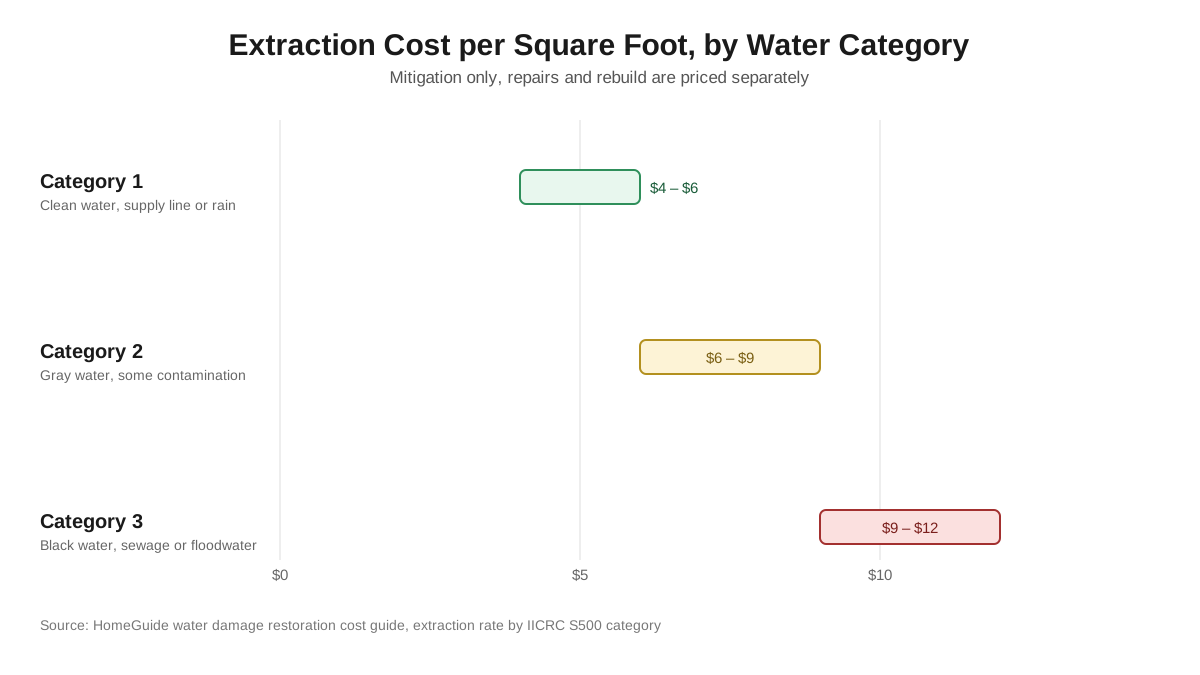
Restoration companies classify water by contamination level under the IICRC S500 standard: category 1 is clean water from a supply line or rainwater, category 2 is gray water with some contamination, and category 3 is black water, sewage, floodwater, or anything that sat long enough to grow bacteria. Water extraction cost tracks that ladder closely, running roughly $3.00 to $6.00 per square foot for category 1 water and climbing to $9.00 to $12.00 per square foot once you're dealing with category 3, since crews need protective equipment and have to treat more material as unsalvageable. See our full guide to water damage categories and classes for the complete breakdown.
Class: how much of the house got wet
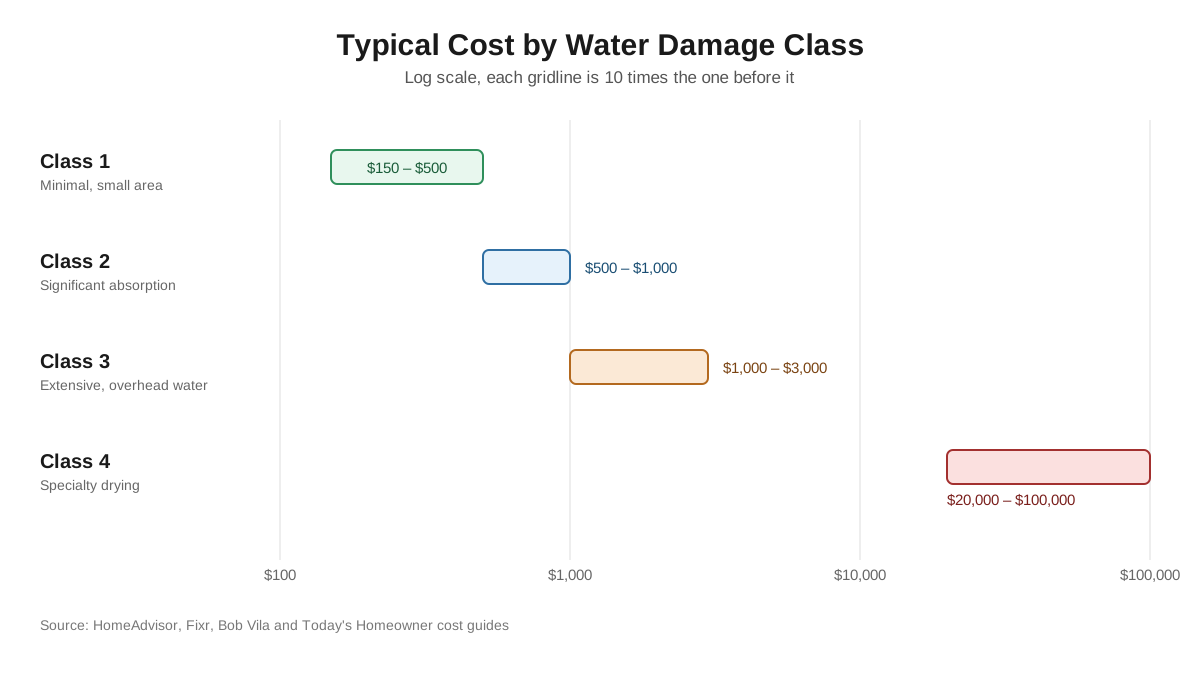
Class describes absorption and drying difficulty rather than contamination. Class 1 means a small area and easy drying, priced at $150 to $400 by HomeAdvisor, Fixr, and Bob Vila alike. Class 4, specialty drying situations like saturated hardwood, plaster, or concrete, is where the range jumps to $20,000 to $100,000.
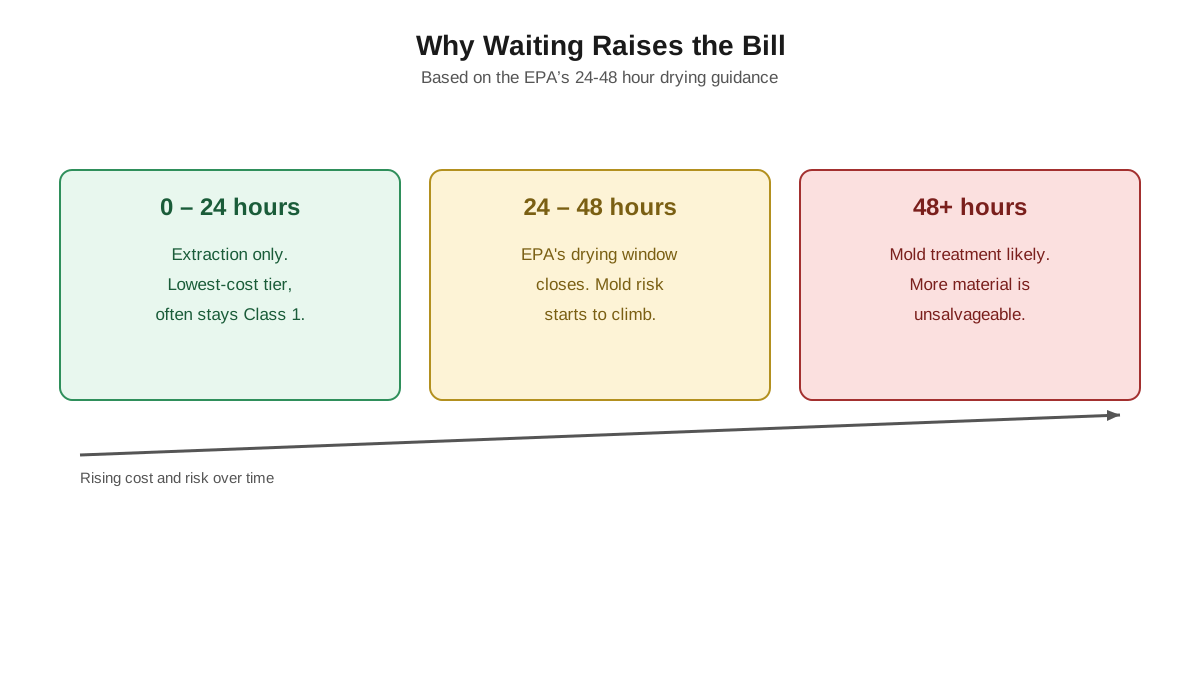
Two more factors round out the list. Square footage multiplies whatever per-square-foot rate your water category sets, so the water damage restoration cost per square foot only becomes a real number once someone measures the affected area. And response time matters almost as much: the EPA's guidance is that materials should start drying within 24 to 48 hours to avoid mold, and every hour past that window tends to turn "dry it out" cost into "replace it" cost.
Extraction rates climb fastest between clean and contaminated water. Source: HomeGuide's water damage restoration cost guide.
How a Company Turns Your Wet House Into a Number
A written estimate isn't a guess pulled from a price sheet. It comes from a short, fairly consistent process that most established restoration companies follow, whether or not you ever see the steps happen.
How a restoration company turns a wet house into a written estimate.
Inspection and moisture readings. A technician walks the space with a moisture meter and often a thermal camera, checking not just visible wet spots but walls, subfloor, and cavities that look dry but aren't.
Category and class assignment. Based on the water's source and how far it traveled, the crew assigns a category (contamination) and class (absorption and drying difficulty) under the IICRC S500 standard.
Mapping the affected square footage, room by room, since per-square-foot pricing only works once the area is measured.
Deciding what's salvageable versus what has to be removed, carpet pad, baseboard, drywall below the flood line, and what can simply be dried in place.
Building line items for equipment (air movers, dehumidifiers), labor hours, disposal, and any repair work, then totaling them into a scope of work.
Presenting a written, itemized estimate, ideally with photos and moisture logs attached, especially if you're planning to file an insurance claim.
For a single soaked room, that walk-through usually happens on the same visit as the first call. Larger or commercial losses take longer, since more of the building has to be mapped before anyone can price it. For the full walkthrough of what happens after the estimate is accepted, see our guide to the water damage restoration process.
Water Damage Restoration Cost by Class and Job Type
These are the ranges published across the major water damage repair cost guides in 2025 and 2026. The exact dollar figures shift by a few hundred dollars from source to source, but the shape of the curve is consistent everywhere.
Typical cost by water damage class, on a logarithmic scale.
By class
Class
What it means
Typical range
Source
Class 1 (minimal)
Small area, low absorption, quick to dry
$150 – $400
HomeAdvisor, Fixr, Bob Vila
Class 2 (significant)
Larger area, carpet and cushion affected
$500 – $1,000
HomeAdvisor, Fixr, Bob Vila
Class 3 (extensive)
Water from overhead, walls and ceiling wet
$1,000 – $3,000
HomeAdvisor, Fixr, Bob Vila, Today's Homeowner
Class 4 (specialty drying)
Saturated hardwood, plaster, concrete or crawl space
$20,000 – $100,000
HomeAdvisor, Fixr, Bob Vila, Today's Homeowner
HomeGuide, another major cost site, publishes noticeably higher class 2 and class 3 figures, $1,500 to $5,000 and $5,000 to $15,000, because its ranges appear to bundle more repair work into the same classification rather than pricing mitigation alone. That's a useful reminder when you compare estimates: ask what's included, extraction and drying only, or extraction plus rebuild, before you compare two numbers side by side.
By job or area
Job or area
Typical range
What moves the price
Source
Basement water damage
$500 – $80,000
Finished vs. unfinished, sump failure vs. flood, mold present
HomeAdvisor
Drywall repair
$300 – $850
Square footage, texture matching, paint
HomeAdvisor
Ceiling repair
$450 – $1,600
Height, structural framing exposure
HomeAdvisor
Kitchen water damage
$1,750 – $8,000
Cabinetry, subfloor, appliances
Fixr
Sump pump install
$640 – $2,000 (avg. $1,200)
Pump capacity, battery backup
HomeAdvisor
Burst pipe repair
$150 – $250 per linear foot
Pipe material, wall access
HomeGuide
Labor and emergency fees
$70 – $200/hr labor; $50 – $200 flat call-out fee, or $120 – $600/hr for after-hours service
After-hours response, crew size
Bob Vila, Today's Homeowner
What Mold Remediation and Sewage Cleanup Add to the Bill
Water damage rarely stays a single-line bill. Two follow-on problems, mold and sewage contamination, show up often enough that it's worth pricing them separately.
Mold remediation
Mold remediation cost runs $1,500 to $9,000 with a national average near $3,500, according to Fixr, while Bob Vila reports a lower average of $2,254 with a typical range of $1,125 to $3,439. Per-square-foot pricing runs $10 to $30 for a contained area like a crawl space or basement; HVAC contamination alone typically runs $3,000 to $10,000, and a whole-home job can reach $10,000 to $30,000. The US EPA notes that a patch smaller than about 10 square feet, roughly a 3-foot by 3-foot section, is usually something a homeowner can handle without a specialist, provided the underlying moisture problem gets fixed too. Our guide on mold after water damage covers how fast that growth actually happens.
Sewage and blackwater cleanup
Sewage cleanup costs $7 to $15 or more per square foot, according to HomeGuide, well above clean or gray water extraction rates. A small, single-room backup handled quickly runs $2,000 to $3,000. A medium, multi-room event runs $3,000 to $7,000. Large contamination climbs to $7,000 to $15,000, and anything requiring extensive structural restoration on top of cleanup can run $15,000 to $50,000 or more. A sewer camera inspection, often the first step in figuring out why the backup happened, runs $125 to $500, and replacing a failed sewer line runs $2,000 to $10,000. See our dedicated guide to sewage backup cleanup for the safety steps that come before any of this pricing matters.
Where You Can Cut the Bill Yourself, and Where That Backfires
Not every wet spot needs a truck in your driveway. The EPA's own guidance draws a rough line at about 10 square feet for category 1 water, small enough for a homeowner to mop, fan-dry, and monitor; anything bigger, more contaminated, or hidden behind a wall calls for equipment and judgment most homeowners don't have on hand.
Task
Usually fine to DIY
Usually better left to a pro
Small category 1 spill, under about 10 sq ft
Mop, wet-vac, box fan and dehumidifier
—
Wet carpet pad or baseboard
Remove and discard if caught quickly
—
Category 2 or 3 water contact
—
Protective equipment, proper disposal
Moisture behind walls or under flooring
—
Moisture meters, thermal imaging
Structural drying, multiple rooms
—
Commercial air movers, daily monitoring
Mold beyond about 10 sq ft
—
Containment and specialized removal
Standing water near an electrical panel
—
Electrician or utility shutoff first
The math that matters here isn't just labor cost, it's speed. A homeowner who wet-vacs a small, clean spill within an hour can genuinely avoid a bill entirely. A homeowner who tries to save money by running a single box fan on a soaked, multi-room floor for four days, past the EPA's 24 to 48 hour drying window, often ends up paying for both the delayed extraction and the mold remediation that followed. DIY drying that fails doesn't just cost the same as calling a pro from the start, it frequently costs more.
When to Call a Pro Immediately, No Matter the Budget
Some situations aren't about comparing prices. They're about stopping damage, or protecting yourself, right now.
If the water is still coming in, whether from a burst supply line, a failed sump pump, or a roof that's actively leaking, stop trying to estimate anything and get the flow stopped first: locate your main shutoff, or the fixture's individual shutoff, and close it. If you can't find it or the leak is beyond a simple valve, call 888-407-9931 and describe what you see to a restoration company that serves your area; many can walk you through an emergency shutoff over the phone while a crew is on the way.
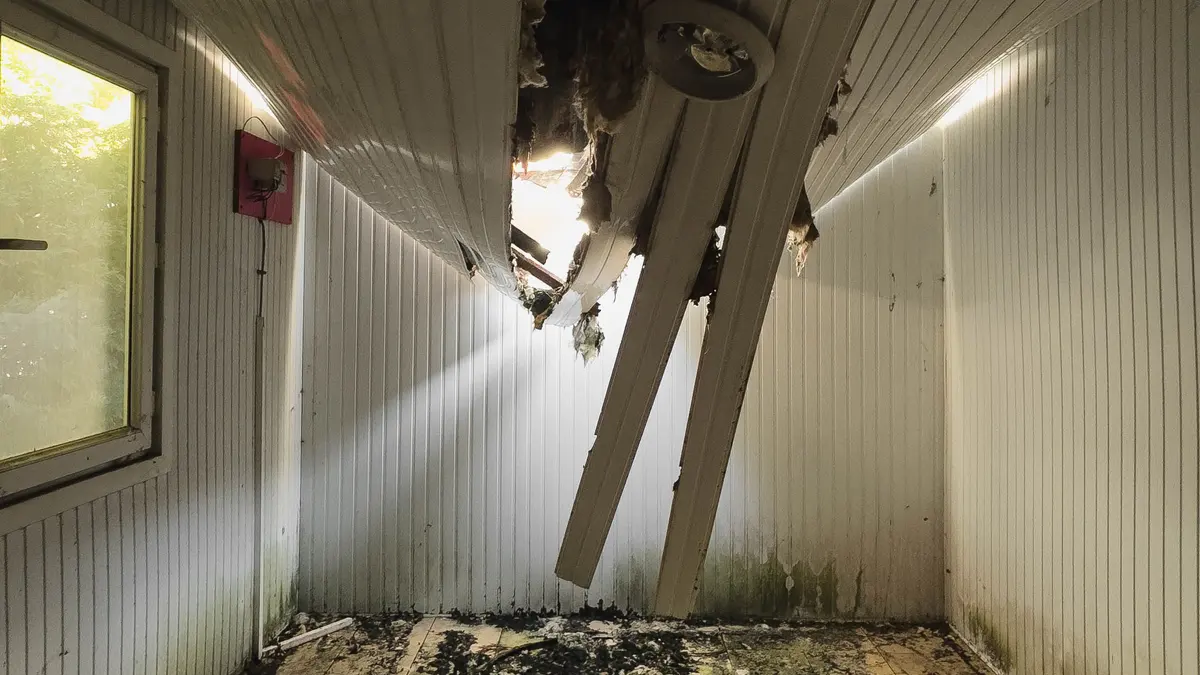
Category 3 water, sewage, floodwater, or anything that's been sitting for days, carries real health risk. Don't wade through it, don't let kids or pets near it, and don't try to save contaminated porous material like carpet or drywall below the flood line. Standing water anywhere near an electrical panel or outlets is a shock and fire hazard; if you can safely reach the main breaker, shut off power to the affected area before doing anything else, and if you can't reach it safely, leave and call for help instead. A ceiling that's visibly sagging or bulging under water weight is a collapse risk, so stay out of that room entirely until it's inspected.
None of this is about saving money by waiting. Every hour past the EPA's 24 to 48 hour drying window tends to move a job toward the next class up, so acting fast is also the cheaper choice, not just the safer one.
How Insurance Changes What You Actually Pay
The sticker price and your out-of-pocket cost are often two different numbers, and the gap between them depends on your policy, not just your plumbing.
Water damage and freezing accounted for 27.6% of homeowners insurance losses in 2022, according to the Insurance Information Institute, citing ISO, a Verisk Analytics business, second only to wind and hail at 40.7%. The frequency was 1.61 claims per 100 house-years, with an average claim severity of $13,954. That's a meaningful share of the roughly $1,411 average homeowners premium reported for 2021 going toward exactly this kind of risk.
Coverage depends heavily on cause. A standard HO-3 policy typically covers sudden and accidental water damage, a pipe that bursts overnight, a water heater that fails without warning, but excludes gradual leaks tied to poor maintenance and, separately, floodwater that enters from outside your home. FEMA notes that just one inch of floodwater can cause roughly $25,000 of damage, and that over 40% of NFIP flood claims come from outside high-risk flood zones, which is why "my homeowners policy covers water damage" and "I'm covered for a flood" are two different sentences. Flood coverage runs through the National Flood Insurance Program or a private flood policy, not your standard homeowners policy.
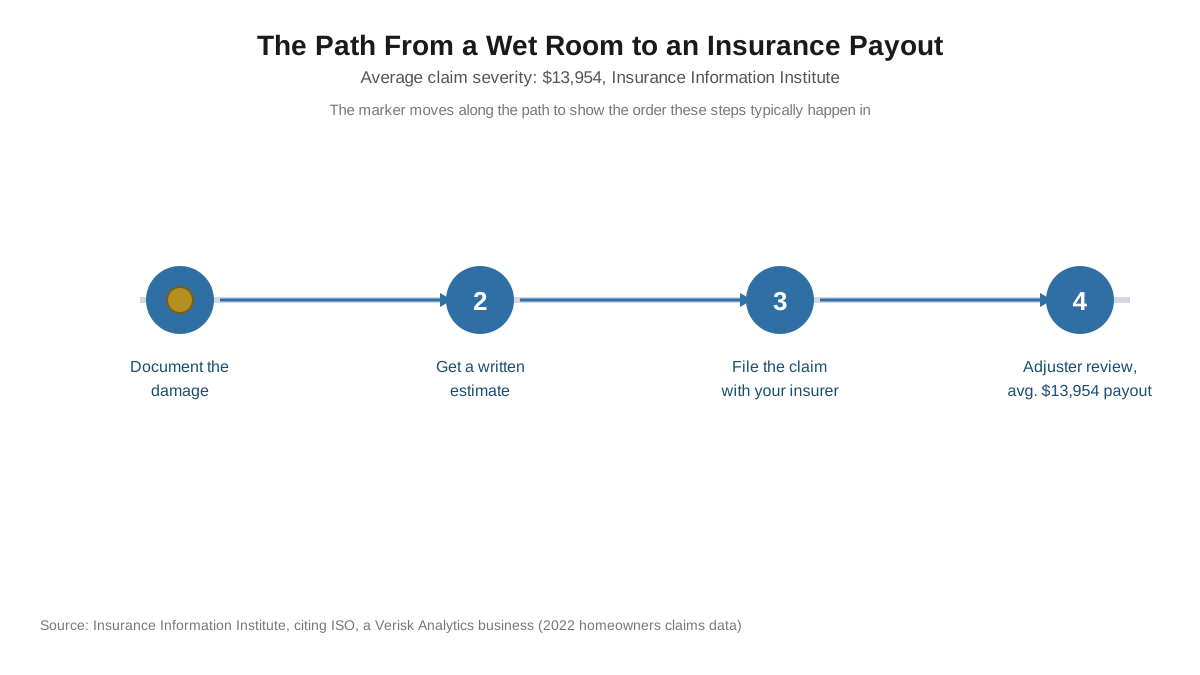
Whatever caused the damage, document it before cleanup starts: photos and video of standing water and damaged material, the restoration company's moisture logs, and an itemized estimate. That paperwork is what turns a $13,954 average claim into an actual, defensible number instead of an argument with an adjuster. Our guide to water damage insurance claims covers the documentation checklist, claims timeline, and specific coverage scenarios in full.
The documentation trail behind a $13,954 average claim payout. Source: Insurance Information Institute, citing ISO, a Verisk Analytics business.
Regional Notes: Freeze Belt, Hurricane Coast and Humid Climates
National ranges are a starting point, not a forecast for your specific address. Three regional patterns show up often enough to call out, even without a local price for your exact street.
Freeze belt: frozen and burst pipes
In climates that see hard freezes, burst pipes are a leading cause of large, sudden losses, often category 1 clean water at first, but a lot of it, since a pipe can run for hours before anyone notices. Burst pipe repair itself runs $150 to $250 per linear foot, before extraction and drying are added on top. Insulating exposed pipes and knowing your main shutoff ahead of time are the cheapest insurance you'll ever buy against this specific bill.
Hurricane and heavy-rain coast
Floodwater that enters from outside is category 3 by definition, contaminated, and it's also the scenario standard homeowners insurance is least likely to cover. FEMA's data that over 40% of flood claims come from outside officially designated high-risk zones matters here specifically, since it means "I'm not in a flood zone" isn't the same as "I don't need flood coverage." Storm-driven jobs skew toward the larger classes in the tables above, since wind-driven rain and storm surge tend to affect more square footage than an indoor pipe failure.
Humid inland climates
Higher ambient humidity slows drying equipment down, which matters directly against the EPA's 24 to 48 hour mold-prevention window. A job that would dry cleanly in three days in a dry climate can need extra dehumidifier time in a humid one, nudging the bill toward the higher end of whatever class it falls into. Keeping indoor humidity below 60%, and ideally between 30% and 50%, per EPA guidance, is a real lever against that extra cost, not just a comfort setting.
None of this replaces a walk-through estimate for your specific house. Think of it as the direction your bill tends to move, not a number to write down.
Getting a Water Damage Repair Estimate You Can Trust
A water damage repair estimate is only as good as what's written on it. Get it in writing, get more than one if the job is large, and read past the total at the bottom.
What a written estimate should include
The water's category and class, and the square footage they were assigned to
Equipment count (air movers, dehumidifiers) and expected run time
A line-item breakdown, not just a single lump sum
Whether repairs and rebuild are included, or only mitigation and drying
A payment schedule and whether the company bills your insurer directly
Certifications and red flags
Look for IICRC certification, the industry body that sets the S500 standard this whole guide is built on, along with proof of general liability insurance and, if your state requires one, a contractor's license you can verify with your state's licensing board. Be cautious of anyone who arrives uninvited right after a storm, pressures you to sign before you've read the estimate, or asks for full payment upfront before any work has started.
Never let a company begin tear-out or ask you to sign anything before you have a written, itemized estimate in hand. Once you've got two or three companies lined up, reach a 888-407-9931 restoration company that serves your area and ask them to walk the property before anything comes out; a company confident in its pricing won't mind you comparing it. For the full list of credentials and questions to ask, see how to choose a water damage company.
How to Keep a Small Leak From Becoming a Five-Figure Job
The cheapest water damage restoration is the one that never happens, and most of the jobs that end up in the class 3 or class 4 range started as something a lot smaller.
Why acting inside the EPA's 24 to 48 hour drying window keeps costs lower.
The clearest lever is speed. The EPA's 24 to 48 hour window for starting drying isn't arbitrary, it's roughly the point where standing moisture turns into mold risk, and mold remediation cost, $1,500 to $9,000 on its own, is exactly the kind of add-on that turns a manageable bill into a much bigger one. Knowing where your main shutoff is before you need it, not while water is spreading across the floor, is free and saves real money.
A handful of specific investments pay for themselves against the numbers in this guide. A sump pump install, $640 to $2,000, averaging around $1,200, is cheap next to the $500 to $80,000 range basement water damage can run once a sump pump fails during a storm. Leak sensors and automatic shutoff valves near washing machines, water heaters, and under sinks catch the kind of slow, unnoticed leak that turns a $150 class 1 job into a $1,000-plus class 2 job simply because nobody was home. Swapping out washing machine and dishwasher supply hoses before they're due to fail, not after they've already split, costs a fraction of what a flooded laundry room or kitchen runs.
Since standard homeowners insurance typically excludes water that enters from outside, keeping gutters clear and grading soil away from the foundation matters as much in a freeze-belt winter as it does before a hurricane-coast storm season, and it costs nothing but an afternoon.
Frequently asked questions
How much does water damage restoration cost?+
Most homeowners pay between $1,200 and $6,369 for a single-incident job, with national averages reported between $3,000 and $3,868 across major cost guides. Small category 1 spills can finish for $150 to $500, while a category 4 disaster with structural drying can run $20,000 to $100,000 or more. Your actual number depends on square footage, water category, and how many hours passed before cleanup started.
What's a realistic water damage repair estimate for one room?+
A single soaked room with clean water usually lands in the class 1 to class 2 range, roughly $150 to $1,000 for extraction and drying, before any drywall, flooring or cabinet replacement is added. Add category 2 or 3 contamination, and the per-square-foot extraction cost alone can double or triple. Ask for the estimate broken into mitigation and repair so you know what each line covers.
How long does water damage restoration take?+
Drying alone typically takes three to five days once equipment is running, based on the EPA's guidance that materials should start drying within 24 to 48 hours to avoid mold. Repairs, replacing drywall, flooring or cabinets, add more time on top of that, from a few days for a single room to several weeks for a class 4 job with structural rebuilding.
What is water damage restoration, exactly?+
Water damage restoration is the professional process of removing standing water, drying out a structure and its contents, and repairing what got damaged, following industry practices set out in the IICRC S500 standard. It starts with inspection and moisture mapping, moves through extraction and structural drying, and finishes with any needed rebuilding, all documented for your records or an insurance claim.
How much does water damage remediation cost compared to full restoration?+
Remediation, stopping the damage and drying the structure, tends to sit at the lower end of a class's range, often a few hundred to a few thousand dollars for a single room, since it doesn't include rebuilding. Full restoration adds repair and reconstruction on top, which is where a job moves from a mitigation-only number toward the $3,000 to $6,000 national average or higher.
How much does water damage mitigation cost?+
Mitigation, the emergency work that stops damage from spreading, extraction, tear-out of unsalvageable material, and setting up drying equipment, is usually billed separately from repairs. For a single room, mitigation alone commonly falls in the class 1 to class 2 range, $150 to $1,000, though a category 3 job with contaminated material removal can run well past that before any rebuilding starts.
How do you estimate water damage repair costs before a company arrives?+
Start with the square footage of the affected area and a rough sense of the water's category, clean, gray, or contaminated black water, since both numbers set the per-square-foot rate a company will likely quote. Multiply the low and high per-square-foot figures by your square footage for a ballpark range, then add several hundred dollars for any drywall, flooring, or cabinetry you expect won't survive drying.
How much does mold remediation cost after water damage?+
Mold remediation typically runs $1,500 to $9,000, averaging around $2,254 to $3,500 depending on the source, with per-square-foot pricing between $10 and $30 for contained areas like a basement or crawl space. HVAC contamination alone runs $3,000 to $10,000, and a whole-home job can reach $10,000 to $30,000. The EPA's guidance is that patches under about 10 square feet are usually manageable without a mold specialist.
Does homeowners insurance cover the cost of water damage restoration?+
Standard HO-3 policies typically cover sudden, accidental water damage, like a burst pipe, but exclude gradual leaks from poor maintenance and floodwater that enters from outside your home. Water and freezing claims made up 27.6% of homeowners insurance losses in 2022 with an average severity of $13,954, according to the Insurance Information Institute, so coverage details matter more than most homeowners expect until they file a claim.
How much does sewage cleanup cost compared to regular water damage restoration?+
Sewage cleanup runs $7 to $15 or more per square foot, well above the roughly $3 to $9 per square foot range for clean or gray water extraction, because contaminated material has to be removed and disposed of, not just dried. A small single-room backup handled quickly can cost $2,000 to $3,000, while a larger or older spill can climb to $15,000 or beyond.
How much does it cost to repair water damage from a small leak?+
A small, clean-water leak caught quickly, a supply line or an overflowing sink, often falls in the class 1 category, $150 to $500 for extraction and drying, since only a limited area absorbed water. Costs rise fast if the leak went unnoticed for days, since standing water spreads under flooring and behind walls, pushing the job into class 2 or class 3 territory.