An HVAC contractor Houston homeowners call for a dead AC on a 95-degree afternoon or a furnace that won't fire on a rare freeze should quote repairs in the national $150 to $700 range and replacements from roughly $2,900 to $10,000, verify an active TDLR ACR license before any deposit, and get every price in writing before a crew starts work.
Type heating and air conditioning Houston into a search bar on a July afternoon with the compressor dead and the house climbing past 85 degrees inside, and the results are mostly paid ads before you reach anything useful. This page is built to be the useful part instead: real national cost ranges, the actual FEMA hazard numbers Harris County carries, and a plain walk-through of what a licensed HVAC contractor should be telling you before any check changes hands.
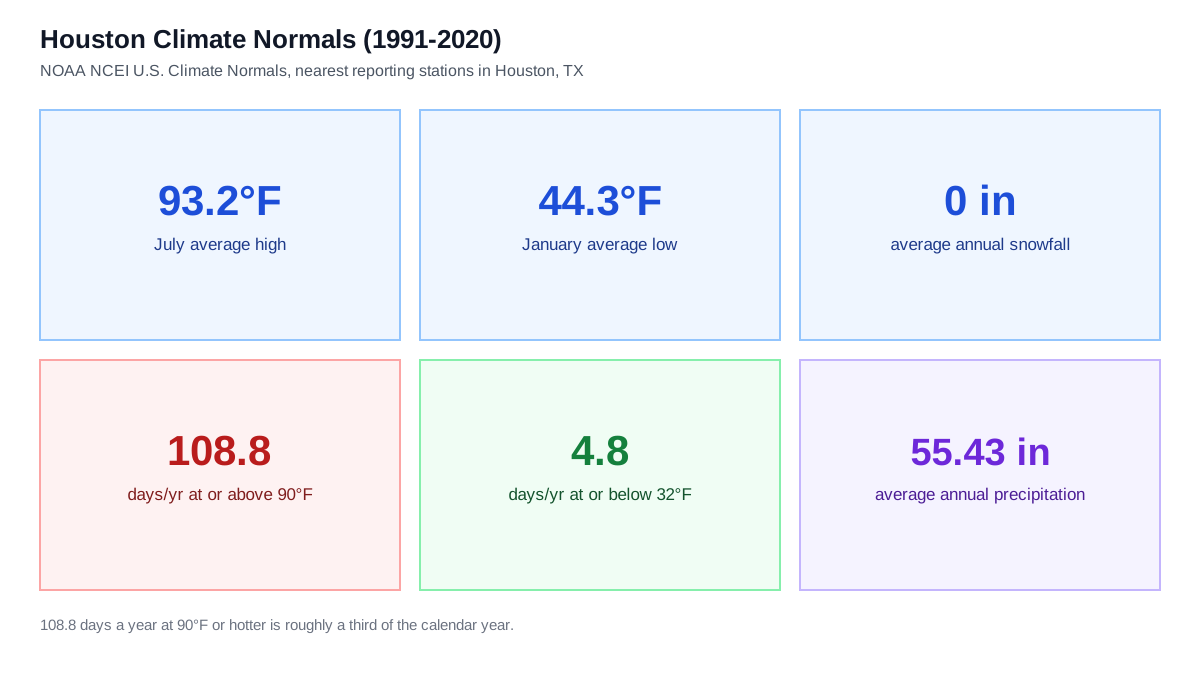
Houston doesn't get cold the way most of the country does. NOAA's 1991-2020 climate normals put the county at 108.8 days a year with a high of 90°F or hotter and only 4.8 days a year at or below freezing, which makes the air conditioner closer to essential infrastructure than a comfort appliance for a third of the calendar year here. It also rains hard — 55.43 inches a year on average — and Harris County's FEMA National Risk Index score sits at 99.9 out of 100, Very High, driven in part by riverine and inland flooding rated Very High with more than five modeled events a year. None of that shows up on a thermostat, but it shapes where equipment gets installed, how fast a small failure turns into a bigger one, and why heating repair calls here cluster around a handful of cold snaps rather than spreading evenly across the year.
The First Hour With a Dead AC or a Furnace That Won't Fire in Houston
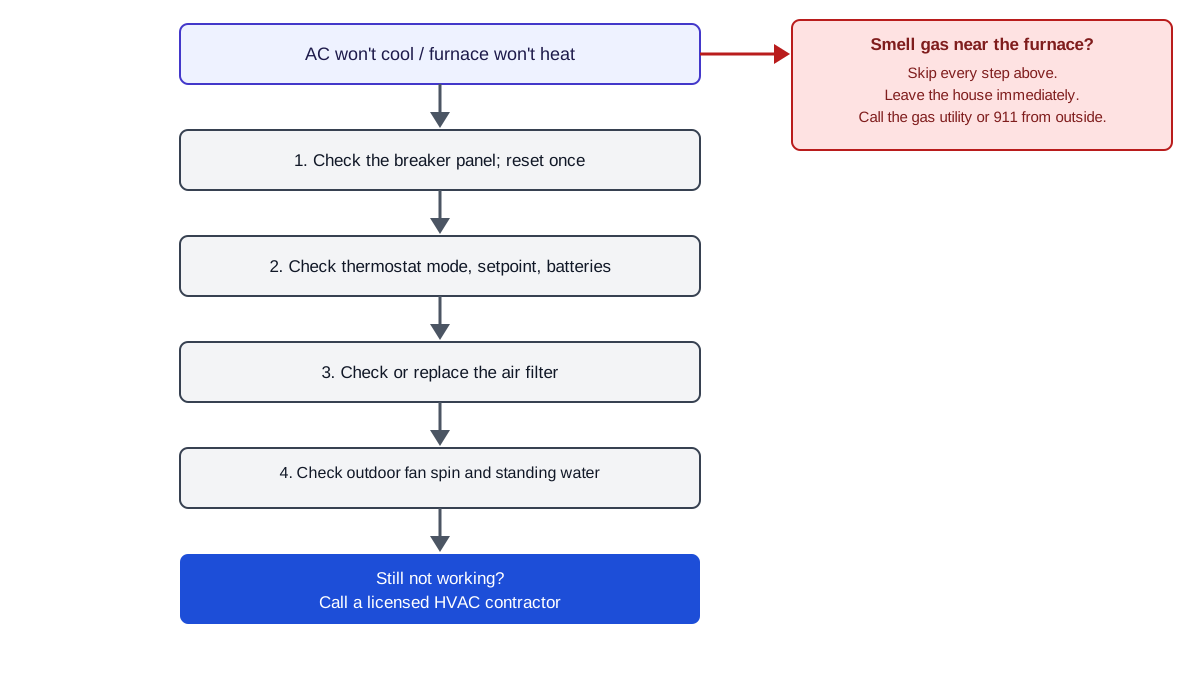
Start with the parts that take thirty seconds and save you a service call. In a city where the AC runs most of the year, a nuisance trip or a dead thermostat battery gets mistaken for a failed compressor more often than people expect.
Walk to the electrical panel and look for a tripped breaker on the AC or furnace circuit. Reset it once. If it trips again right away, stop there — that's an electrical fault, not something to keep flipping.
Check the thermostat: confirm it's set to Cool or Heat, that the setpoint differs from the room temperature, and, if it runs on batteries, swap in fresh ones before assuming the equipment has failed.
Pull the air filter and hold it up to a window. Houston's humidity feeds mold and dust buildup faster than a dry climate does, and a filter you can't see light through is likely your whole problem, the most common cause behind an ac not cooling or ac short cycling call here.
Go outside and look at the condenser. If the fan isn't turning, don't reach into it. After heavy rain, glance at whether the unit is sitting in standing water; Harris County's flood exposure makes that worth checking first.
One situation skips this list entirely: if you smell gas anywhere near the furnace or the gas meter. Leave the house immediately, don't flip a light switch or light anything on your way out, and call the gas utility or 911 once you're clear. That's not a step to weigh against convenience.
A procedural checklist, not a substitute for professional diagnosis. If any step feels unsafe, stop and call a licensed technician.
None of the checklist applies if it's a no cooling emergency during a run of 95-plus-degree afternoons and someone in the house is medically vulnerable — an infant, an elderly resident, anyone with a heart or lung condition. FEMA models roughly 14.9 heat-wave events a year here, so that's not rare; skip straight to emergency ac repair or same day ac repair and sort out the cause afterward.
Why HVAC Systems Fail the Way They Do in Harris County
Houston sits in Harris County, inside the Houston-Pasadena-The Woodlands metropolitan statistical area, with the city itself home to roughly 2.39 million people as of the Census Bureau's 2024 estimate. FEMA's National Risk Index rates the county's overall risk score at 99.9 out of 100, Very High — among the highest anywhere in the dataset. Unlike counties that earn that rating from one dominant hazard, Harris County gets there from a stack of them: flooding, hurricane wind, heat, and lightning all carry the same Very High tier at once.
The climate itself explains a lot of what a technician sees on a call. NOAA's 1991-2020 normals put the July average high at 93.2°F and the January average low at 44.3°F; the county logs 108.8 days a year at or above 90°F and just 4.8 days at or below freezing. That's not only heat: annual precipitation averages 55.43 inches, and humidity changes what an air conditioner actually does, since a large part of the job is pulling moisture out of the air (latent load, in HVAC terms), not just dropping the temperature. An oversized unit that cools a room fast without running long enough to dehumidify leaves a house feeling clammy at the right thermostat setting.
NOAA NCEI U.S. Climate Normals (1991-2020), nearest reporting stations within a few miles of central Houston.
Two FEMA ratings matter more here than in most of the country. Riverine/Inland Flooding is rated Very High, with a frequency of roughly 5.1 modeled events a year, among the highest flood frequencies FEMA tracks nationally. That's directly relevant to HVAC because a lot of Houston homes keep the furnace or air handler in a garage or first-floor closet, closer to floodwater than equipment mounted higher up. Lightning is rated Very High too, near 74.6 events a year, the single most frequent hazard here, and it's the practical reason a surge protector on the condenser's disconnect isn't overcautious.
FEMA National Risk Index county-level hazard scores, 0-100 scale, version 1.20, December 2025 release.
Severity and frequency tell different stories for the rest of the list. Hurricane carries the maximum severity score, 100, Very High, yet FEMA models it at only about once every five and a half years; ice storm and cold wave rate Very High too, both under one event a year. Heat Wave, also Very High, is modeled at roughly 14.9 events a year — closer to continuous exposure than a rare one. Read together, the furnace faces a rare, high-severity risk that catches people unprepared, while the AC faces a near-constant load that wears equipment down faster.
None of that is abstract when the invoice arrives. The Bureau of Economic Analysis's regional price parity data for this metro puts overall prices at 98.6% of the national average and services/utilities at 95.3%, both slightly below the national baseline. That's not an HVAC-specific index, but it signals quotes here tend to land near or under the ranges below, not stacked at the top.
What People in Houston Are Actually Searching For
Emergency and After-Hours Calls
Almost nobody researches hvac repair before something breaks. Emergency hvac service, 24 hour ac repair, and same day ac repair searches spike hardest in July and August, when a dead compressor at two in the afternoon on a 95-degree day is not a minor inconvenience for anyone medically fragile in the house. Emergency furnace repair searches run smaller but sharper, clustering around the handful of nights the temperature nears freezing, on a system that usually sat unchecked all the warm months before.
AC Symptoms: Warm Air, Leaks, Noise and Frozen Coils
An ac blowing warm air complaint usually points to a low refrigerant charge, a failed compressor, or a thermostat stuck in the wrong mode. Ac not turning on is more often the breaker, a blown fuse, or a dead capacitor (the small part that stores the charge a compressor needs to start), leaving the outdoor fan humming uselessly. Ac leaking water inside shows up constantly in a climate this wet, almost always a clogged condensate drain rather than refrigerant, since algae grows faster in humid air than dry air. Ac frozen up, visible ice on the indoor coil, comes from restricted airflow or low refrigerant, and running a frozen system only makes it worse. Ac making loud noise spans a rattling cabinet, a squeal from a belt or bearing, or a bang from a broken part, while ac short cycling often traces to an oversized unit that can't run long enough to dehumidify, plus a dirty filter or low refrigerant. Outside ac unit not spinning is almost always the capacitor, the fan motor, or a tripped breaker.
Furnace, Heat Pump and Thermostat Symptoms
Furnace not igniting is the most common furnace complaint nationally, roughly in this order: a dirty flame sensor, a failed ignitor, or a blocked vent. Furnace blowing cold air often means fan-only mode, a mid-cycle ignitor failure, or, on a heat pump, a stuck defrost cycle, and furnace short cycling shares most of the same causes as its AC counterpart. A heater not turning on or no heat in house call, especially during the year's first real cold snap, disproportionately involves a furnace nobody checked all year. Heat pump not heating adds a wrinkle: a unit stuck in defrost, or with a failed auxiliary heat strip, can run a long time while barely warming the house. Thermostat not working spans dead batteries to a smart thermostat that isn't wired for compatibility, a real limitation, not user error.
Component Failures Behind Most Service Calls
A short list of parts accounts for most failures. An ac refrigerant leak gets diagnosed with an electronic detector or UV dye, not guesswork, since federal law restricts who's allowed to handle refrigerant. Ac compressor not working is the single most expensive AC failure, and on an older unit a technician often recommends full replacement over a swap; ac capacitor replacement, by contrast, is one of the cheapest fixes here. An evaporator coil leak tends to show up as cooling that quietly worsens over weeks, blower motor replacement comes up when airflow drops sharply with the filter still clean, and ac drain line clogged is the cheap, boring fix behind a surprising share of "my AC is leaking water" calls.
Commercial and Rooftop Units, and the Brand Question
Commercial hvac repair and commercial ac repair cover different ground from a homeowner call. Rooftop hvac unit repair on a packaged unit serving a restaurant kitchen means weighing downtime against repair cost, since a closed kitchen loses money every hour it sits without climate control. On the brand question, a Trane, Carrier, Lennox, Goodman, Rheem, or any other major-brand system, including a Daikin or Mitsubishi ductless mini-split, differs mainly in parts availability and warranty terms, not in which technicians can work on it: any licensed, EPA-certified technician can service any of them.
Cost Questions and "Best Company" Searches
Ac replacement cost and new furnace cost rank among the highest-volume searches here, alongside ac repair estimate — people want a number before they'll even call. The best hvac company search is the one this page won't pretend to answer with a name: we hold no verified performance data on individual Houston contractors, so nothing here ranks or endorses one. The hiring section below gives you the credentials to check yourself instead.
What a Proper Repair or Installation Actually Involves
A diagnostic visit should follow a sequence, not a guess. A competent technician checks electrical draw at the disconnect, measures refrigerant pressures against the manufacturer's target using superheat and subcooling readings instead of topping off the charge, and inspects the condensate system and ductwork first. Topping off refrigerant without finding the leak isn't a repair, it's a stall — the charge leaks back out, and you've paid for the same visit twice.
An ac installation or furnace installation follows a stricter standard than a repair, and it matters more in a humid climate than a dry one. The Air Conditioning Contractors of America's manuals call for Manual J to calculate a home's actual heating and cooling load and Manual S to match equipment to it, whether that's a straight air conditioning repair swap or a full heat pump repair and reinstall. Get that calculation wrong in a metro logging 108.8 days a year above 90°F, and the result cools fast without running long enough to pull the humidity out. A crew that skips the load calculation and installs "the same size as what was there" is doing it the fast way, not the right way.
Anyone handling refrigerant needs EPA Section 608 certification under the Clean Air Act, a federal requirement covering anyone who could release refrigerant into the atmosphere while servicing equipment. Many of the stronger shops also carry technicians with NATE certification, a voluntary credential that tests real HVAC knowledge rather than just handing out a card.
Timeline matters too. A same-day diagnostic visit is normal, and a repair using an in-stock part often finishes in that visit. A full replacement is bigger: expect a crew on-site most of a day, a permit pulled through the city or county building department for anything touching new ductwork, electrical, or gas connections, and a final inspection before the job closes out. Duct cleaning sometimes gets bundled into a replacement quote; it earns its cost when ducts show visible mold, more common here than in a dry climate, and it's wasted money as a routine add-on otherwise.
What It Costs in Houston
Nobody publishes an HVAC-specific price index for Houston, so treat every figure below as a national research range, not a local quote. The numbers come from three independent 2025-2026 cost surveys — HomeGuide, Fixr, and HomeAdvisor — cross-checked against each other rather than pulled from one source. The BEA's regional price data puts this metro at 98.6% of the national average overall and 95.3% on services and utilities, so expect quotes near the middle of these ranges or a little below. A written estimate from a licensed local contractor is still the only number that applies to your house.
Repair / Job
Typical Range
What Moves the Price
Source
Basic service call / diagnostic
$75 – $200
Time of day, distance, complexity of the symptom
HomeGuide
AC repair (overall average)
$250 – $700
Which component failed, parts availability, unit age
Fixr
Furnace repair (overall average)
$349 – $650
Fuel type, part cost, access difficulty
Fixr
Capacitor replacement
$100 – $400
Capacitor size and rating, brand of unit
Fixr
Thermostat replacement
$150 – $500
Smart vs. basic model, wiring compatibility
Fixr
Blower motor replacement
$150 – $2,000
Variable-speed motors cost far more than standard ones
HomeAdvisor
Evaporator coil replacement
$400 – $2,700
Coil size, refrigerant type, labor to access it
Fixr
Compressor replacement
$600 – $3,000
Compressor size, whether the unit is still under warranty
Fixr
Refrigerant leak repair
$200 – $1,500
Leak location, refrigerant type, how much recharge is needed
Fixr
Furnace ignitor replacement
$100 – $250
Ignitor type, furnace brand and age
HomeGuide
Heat exchanger replacement
$1,000 – $3,000
Often close to replacement cost; ask about total system age first
HomeGuide
Emergency / after-hours labor rate
$140 – $300 per hour
Time of night, holiday, how far the crew has to travel
HomeGuide; Fixr
National cost ranges compiled from the repair cost table above (HomeGuide, Fixr, HomeAdvisor, 2025-2026 surveys). Houston's regional price index runs near or slightly under the national average, per BEA data.
Full replacement is a bigger decision, and the range widens accordingly.
System
Typical Range
Source
Central AC replacement (full system)
$2,900 – $9,000
HomeAdvisor
Ductless mini-split system
$1,900 – $16,100
HomeAdvisor
Gas furnace replacement
$3,800 – $10,000
Fixr
Electric furnace replacement
$1,800 – $7,300
Fixr
New ductwork (whole system)
$1,000 – $5,000 (avg. about $2,000)
HomeAdvisor
Annual maintenance plan / tune-up
$100 – $300
HomeAdvisor
One more data point for anyone weighing a bigger upgrade against resale value: the 2025 Cost vs. Value report puts a full HVAC electrification conversion at an average job cost of $19,484, recouping about $14,053 (72%) at resale — a national figure for full electrification projects, not a routine repair or a like-for-like swap.
Two Texas-specific rules matter before anyone hands you an invoice. Under state comptroller guidance, labor to repair, remodel, or restore a residential property in Texas isn't subject to sales tax, though materials generally are; labor on nonresidential (commercial) real property works differently, and the total charge is taxable there. And Texas has no single statewide building code for site-built housing: cities and counties, including Houston, administer their own permitting under a baseline adopted from the International Residential Code, so permit rules are a local matter. For unit-size and SEER-rating breakdowns beyond the ranges here, see our AC replacement cost guide.
Insurance and Claims in Texas
A standard HO-3 homeowners policy in Texas, like most HO-3 policies nationally, typically covers sudden and accidental damage — a tree limb crushing a condenser, an electrical fire that takes out the furnace — while excluding ordinary wear and tear or mechanical breakdown from age. A compressor that fails after fifteen years of normal service is unlikely to be a covered claim; equipment destroyed by a covered peril like fire usually is. One exclusion matters more here than in most states: standard HO-3 coverage excludes flood damage, and with Harris County's Very High FEMA rating for riverine and inland flooding, equipment mounted low, like a garage furnace, needs a separate flood policy to cover it if water reaches it.
The Texas Department of Insurance is the state regulator for homeowners insurance complaints and licensing questions, and its site is the place to verify an adjuster's license or file a complaint if a claim feels mishandled. If you do have a covered loss, keep dated photos of the damaged equipment before anything gets hauled away, ask the contractor to save the failed parts if possible, get a written diagnosis explaining the cause of failure rather than just the fix, and keep every invoice. A public adjuster, hired directly by you, works for your interests and typically takes a percentage of the settlement; the adjuster your insurance company sends works for the carrier.
How to Vet an HVAC Contractor in Houston
Every legitimate hvac contractor operating in Texas needs a license through TDLR's Air Conditioning and Refrigeration Contractors program, and the rule is stricter than in many states: a company must employ a licensed ACR contractor at every permanent location, and individual technicians carry their own TDLR registration. Verify a company's license status through TDLR's public search, linked from our Texas HVAC licensing page, before letting anyone into your house; it takes about two minutes.
There's a specific TDLR carve-out worth knowing for a daikin mini split repair or mitsubishi mini split repair: TDLR exempts small, self-contained ductless units of three tons or less from licensing, but its own FAQ specifically excludes mini-splits from that exemption. A mini-split install in Texas generally still requires a licensed ACR contractor, even though it looks like the kind of small unit that would otherwise qualify.
Beyond the license, ask for proof of general liability insurance and, if the company has employees, workers' compensation — if someone gets hurt on your property and the company isn't insured, that liability can land on you. Ask whether the technician doing refrigerant work carries EPA Section 608 certification, federally required, and whether the company has any NATE certified technicians on staff, a voluntary credential but a real signal of tested competence.
An HVAC contractor Houston homeowners can actually trust hands you a written estimate before work starts: it names the specific parts being replaced by make and model, not just "compressor"; separates labor cost from parts cost; states whether a permit is included and who's pulling it; spells out the warranty on both parts and labor; and lands on a firm total, not a range that can move once the truck is in the driveway.
Red flags: no license number, a demand for full payment upfront, high-pressure "today only" pricing, a full-replacement quote that skips the load calculation, or reluctance to put the scope of work in writing. No single one proves a scam, but together they're a pattern worth taking seriously. On the best hvac company question: this page has no verified performance data on individual Houston contractors, so it won't manufacture a ranking; the license lookup and checklist above are the reliable substitute.
What You Can Safely Handle Yourself, and Where That Stops
A fair amount of HVAC upkeep is legitimately within reach for a homeowner: changing the filter every one to three months (more often in this humidity), clearing debris and keeping two feet of clearance around the outdoor condenser, rinsing (not power-washing) its fins with a garden hose, replacing thermostat batteries, and flushing the condensate drain line from its outside access point with a wet/dry vacuum or a cup of distilled vinegar.
Situation
Try Yourself
Call a Licensed Pro
Thermostat blank or unresponsive
Replace batteries, check the breaker
If wiring or smart-thermostat compatibility is the issue
Weak airflow
Replace the filter
If airflow stays weak with a fresh filter
Outdoor fan not spinning
Clear debris and leaves around the unit
If the capacitor or fan motor is suspect
AC leaking water inside
Flush the drain line from the outside access point
If the clog is inside the wall or the coil is frozen
Water pooling near the outdoor unit after rain
Confirm the pad isn't sitting in standing water
If the unit was actually submerged
Gas smell near the furnace
Nothing — leave the house
Always, plus the gas utility
Suspected refrigerant leak
Nothing — handling is federally restricted
Always
The line sits at anything involving refrigerant, gas, or the electrical components behind the disconnect panel. Refrigerant handling is federally regulated: Section 608 of the Clean Air Act restricts its purchase and handling to certified technicians, and that's not a suggestion, it's the law. Gas line work, heat exchanger inspection, and control-board diagnostics call for tools and training well past a weekend project. Opening the electrical disconnect without cutting power first is exactly the kind of shortcut that turns a $200 repair into an emergency-room visit.
A reasonable filter for deciding: does the fix involve touching refrigerant, gas, or anything behind a high-voltage panel? If so, that's a professional job no matter how simple the symptom looks. And if your furnace fails on one of the rare cold nights here and you're tempted to run a space heater as a stopgap, do it carefully and never overnight unattended; nationally, space heaters cause roughly a third of home heating fires and close to nine in ten heating-related deaths, per NFPA data.
Preventing Breakdowns in Houston's Climate
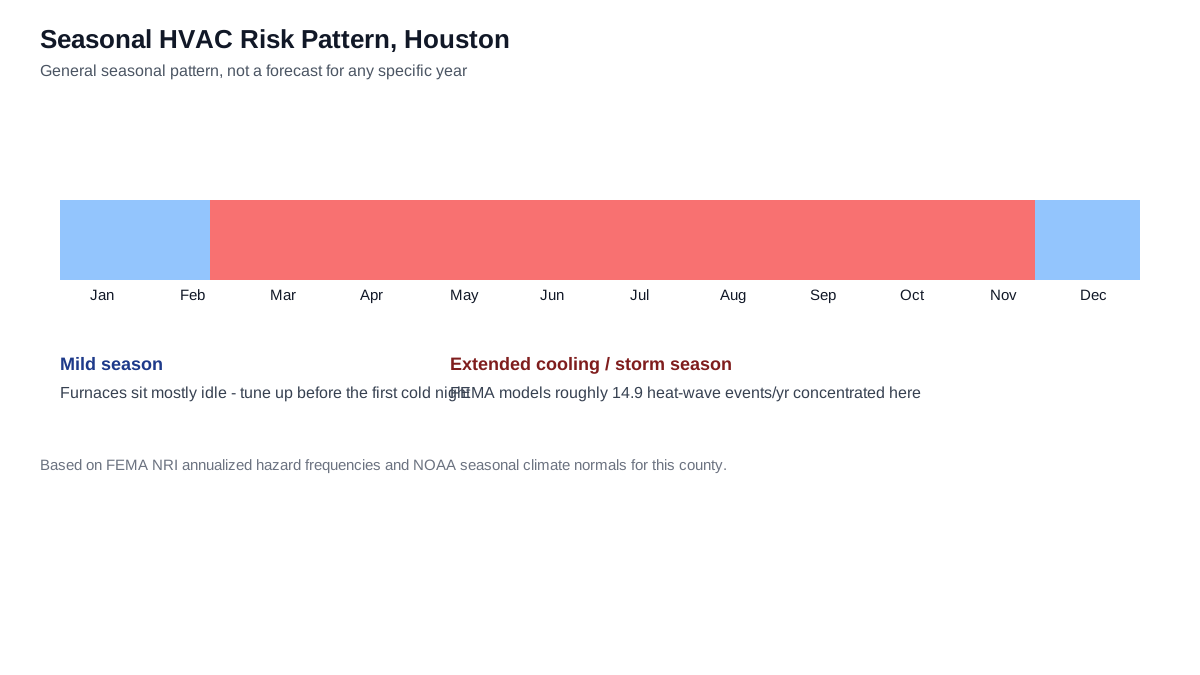
Because this county runs hot and wet for most of the year, the prevention calendar looks different here than almost anywhere outside the Gulf Coast. Schedule an hvac maintenance tune-up in early spring, ahead of the 108.8-day stretch at or above 90°F, not during it — a system already stressed going into that window is the one most likely to fail on the worst day to lose it. Check or replace the air filter more often than the package recommends; humidity encourages faster dust and biological buildup here, and a clogged filter does double duty as an airflow problem and a moisture problem.
General seasonal pattern for this county based on FEMA NRI annualized hazard frequencies and NOAA seasonal climate normals, not a forecast for any specific year.
Lightning is rated Very High for this county, with a modeled frequency near 74.6 events a year, the most frequent hazard on the whole list. A surge protector at the outdoor unit's disconnect is a genuinely cheap way to protect a control board from a strike that's statistically likely nearby most years. Duct sealing and cleaning earns its cost here more than in a drier city, since sealed ducts keep both humid outside air and storm debris out of the system.
Winters here are so mild that the furnace is the system most likely to get neglected; it's easy to forget a machine that only runs a handful of weeks a year. A fall maintenance check before the first real cold snap catches a failing ignitor or a dirty flame sensor while it's still a $100–$250 fix instead of a family finding out at six in the morning that the furnace won't start.
Flood risk, rated Very High for Harris County with more than five modeled events a year, is worth one line even though it sits outside HVAC's usual territory: where practical during a replacement, raising a garage-mounted furnace onto a platform above the floor reduces how much it has to survive the next time water gets in.
Frequently asked questions
How much does HVAC repair cost?+
HVAC repair typically runs $150 to $450 nationally, with AC service averaging around $319 and furnace service around $268, per HomeGuide's cost survey. A capacitor swap lands near the bottom; a compressor or heat exchanger replacement lands much higher. Houston has no HVAC-specific price index, but its cost-of-living index runs close to the national average, so quotes here should land near the middle of these ranges. Get a written estimate first.
How much does air conditioner repair cost?+
Air conditioner repair costs $250 to $700 on average nationally, per Fixr, with a typical average around $375. Minor fixes like a capacitor run $100 to $400; a full compressor replacement can reach $3,000. The exact number depends on which part failed and how old the unit is — a diagnostic visit, usually $75 to $200, is the only way to know which end of that range applies to your system.
How much does furnace repair cost?+
Furnace repair averages $318 to $485 depending on the source, with a typical range of roughly $133 to $650 covering most jobs, according to HomeAdvisor and Fixr. An ignitor or flame sensor replacement sits near the low end, around $100 to $250; a cracked heat exchanger can run $1,000 to $3,000 and sometimes makes more sense folded into a full furnace replacement, especially on an older unit.
How much does HVAC maintenance cost?+
A routine annual tune-up or maintenance plan typically runs $100 to $300, according to HomeAdvisor, and it's one of the cheaper ways to avoid a much larger repair bill. In a climate where the AC runs 108.8 days a year at 90°F or hotter, a spring tune-up specifically pays for itself by catching a weak capacitor or a dirty coil before the worst heat of the year finds it first.
How much does an HVAC service call cost?+
A basic HVAC service call or diagnostic visit runs $75 to $200 nationally, per HomeGuide, before any repair work begins. That fee usually gets credited toward the repair if you go ahead with the work. Emergency or after-hours visits cost more, typically $140 to $300 an hour, since technicians are being pulled in outside their normal schedule.
Does insurance cover HVAC repair or replacement in Texas?+
Usually not, if ordinary wear and age caused the failure — standard HO-3 policies typically exclude mechanical breakdown. Coverage is more likely if a covered peril caused the damage, like a fire or a falling tree branch. HO-3 policies also exclude flood damage, and Harris County's FEMA flood rating is Very High, so equipment mounted low needs a separate flood policy. Check your declarations page, or contact the Texas Department of Insurance if a claim seems mishandled.
Why is HVAC repair so expensive?+
Parts, licensed labor, and liability insurance all cost more than people expect, and HVAC work legally requires federal EPA certification just to touch refrigerant. In a climate that runs the AC almost year-round, equipment wears out faster than it does somewhere milder, pulling more repairs into major-component territory. The other factor: many costly repairs are early-warning replacements in disguise, since fixing an old compressor can cost nearly as much as a new system.
Can I repair my own HVAC system, or install my own mini-split?+
Some of it, yes — filter changes, clearing debris around the outdoor unit, resetting a tripped breaker, and swapping thermostat batteries. Refrigerant, gas lines, and anything behind the disconnect panel are not: refrigerant handling is federally restricted to EPA-certified technicians. In Texas, even a small ductless mini-split doesn't qualify for TDLR's small-unit exemption; mini-splits are explicitly excluded, so that job still calls for a licensed ACR contractor.
How do I find a good HVAC company in Houston?+
Start by confirming the company holds an active license through TDLR's Air Conditioning and Refrigeration Contractors program, verified through the state's public license search, then ask for proof of liability insurance and any NATE-certified technicians on staff. A trustworthy contractor gives you a written estimate that separates labor from parts and lands on a firm total. This page doesn't rank or endorse specific companies; checking credentials yourself is the reliable part.
Is HVAC repair labor taxable in Texas?+
Generally no, for a home you live in: Texas doesn't tax labor to repair, remodel, or restore residential real property, though materials usually are taxable, per the state comptroller's guidance. Labor on a commercial building follows a different rule; the entire charge, labor and materials combined, is taxable there. Ask your contractor to itemize the invoice.